When possibilities cancel. Add first, square last
Ordinary chances can only pile up. Quantum possibilities meet like ripples before they become chances, so a second way in can make a spot darker.
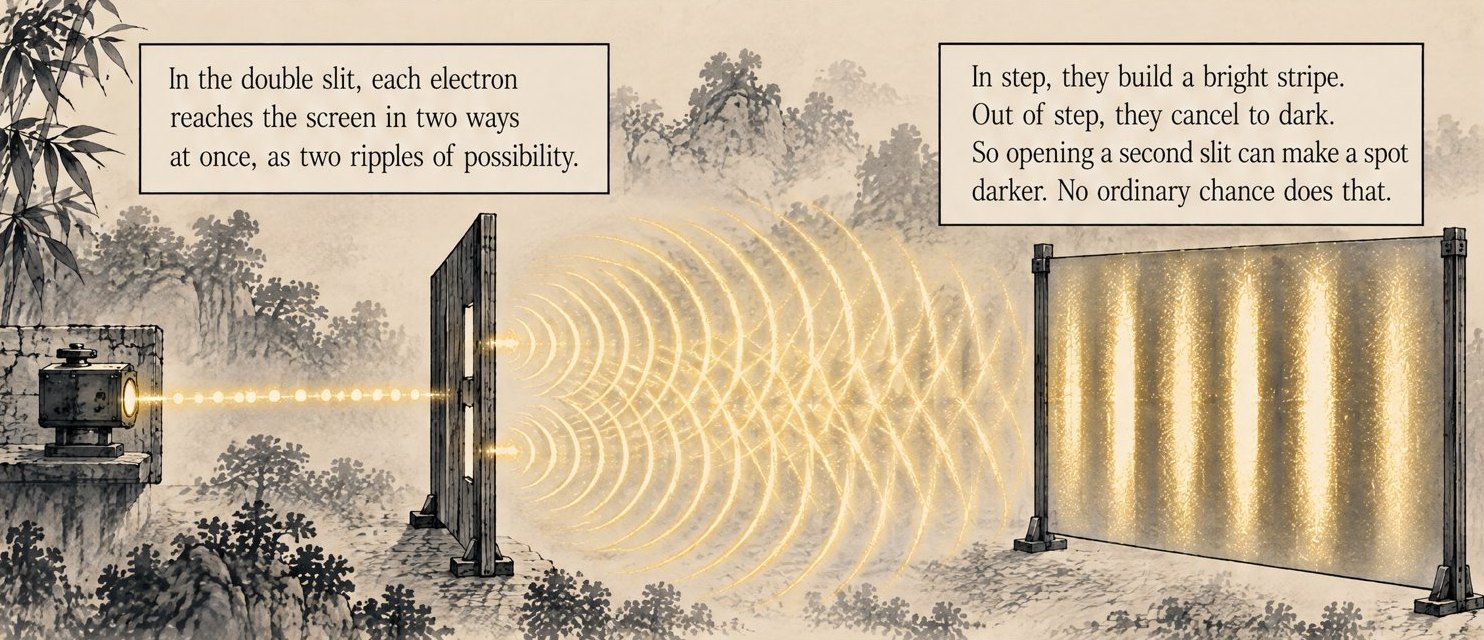
Ordinary chances only add
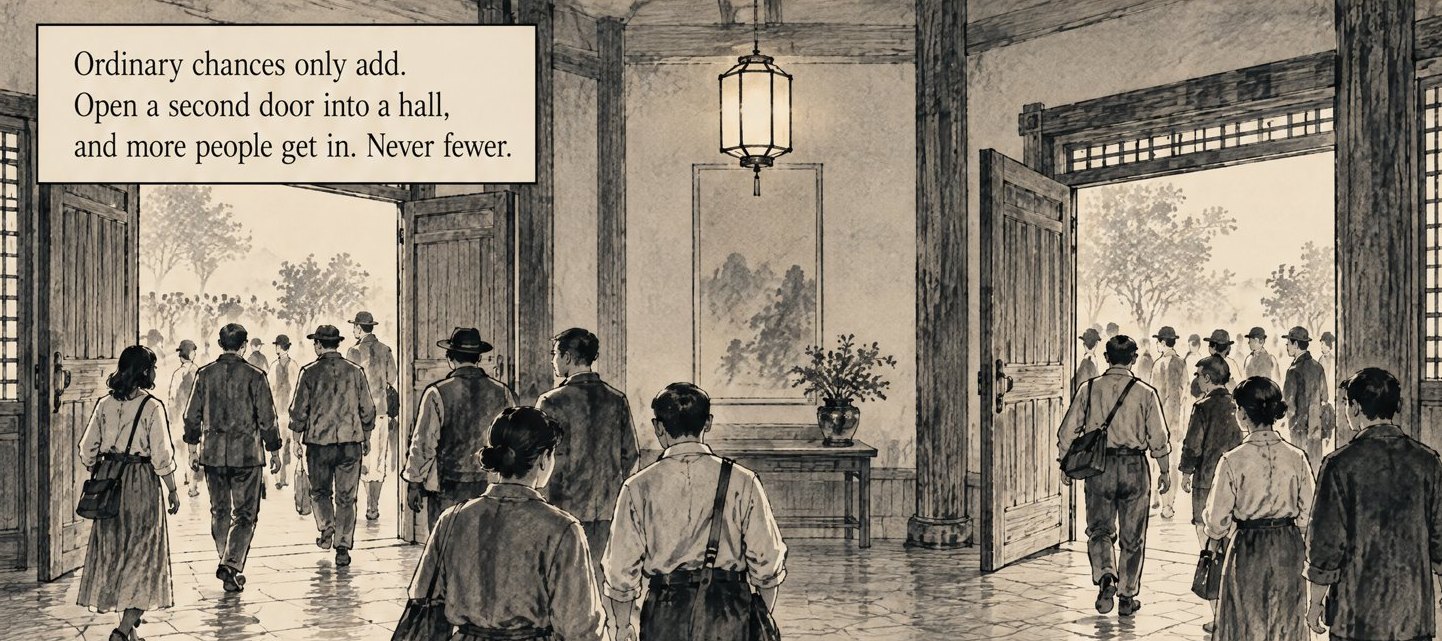
A chance runs from 0, never, to 1, certain. It can never be less than nothing. So when there are two separate ways into the same place, their chances simply add. Open a second door into a hall and more people get in, never fewer. Each person uses one door or the other, and a door can only let people in. Open the second door and set how busy each one is. Watch the total bar: it can only grow.
The maths of chance began with dice games. In 1654 Blaise Pascal and Pierre de Fermat worked out a gambling puzzle in letters to each other. Since then one rule has held for every everyday kind of chance, from dice to weather forecasts: for two ways that cannot both happen, add the chances. Because no chance is ever below zero, adding a way in can never make an arrival rarer. Keep that in mind. The double slit breaks it.
For two ways that cannot both happen:
So P(A or B) ≥ P(A): a second way in can never lower the total.
Ripples can cancel
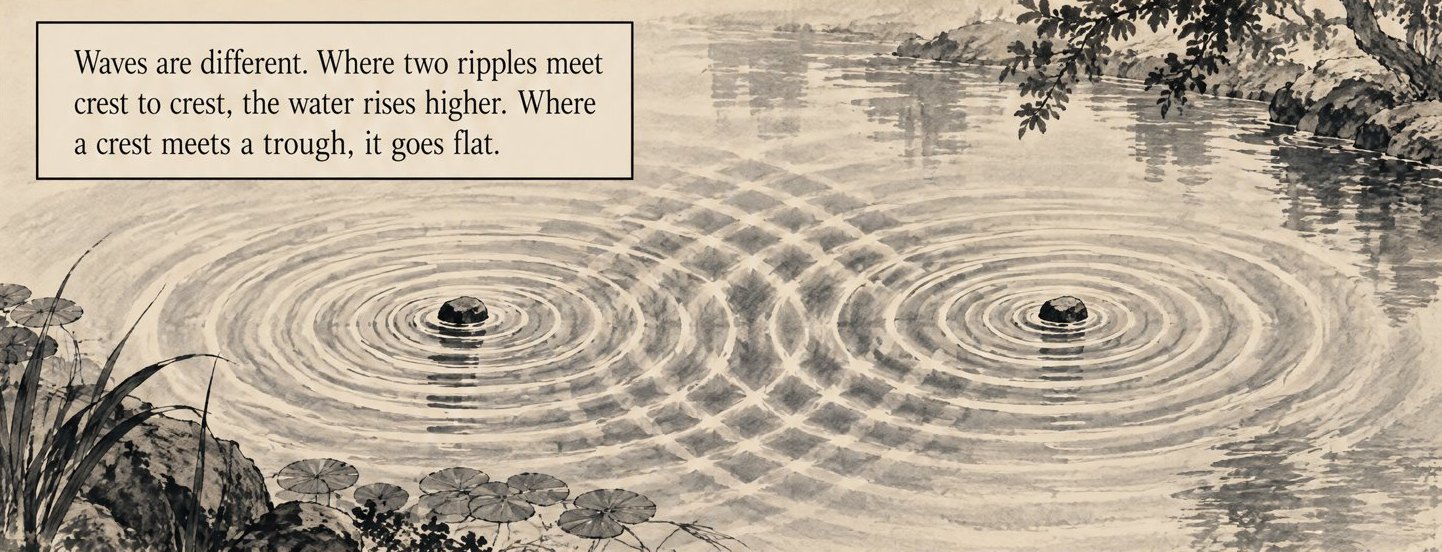
Waves are different. A ripple has a height that can be up, at a crest, or down, at a trough. When two ripples meet, their heights add. Crest on crest, the water rises twice as high. Crest on trough, up plus down makes nothing, and the water goes flat. Noise cancelling headphones do this on purpose with sound. Slide ripple 2 along. At half a wave, every crest lands on a trough and the sum goes flat.
Noise cancelling headphones carry a small microphone that hears the noise outside. A chip makes the same wave flipped upside down and plays it into your ear, and the two cancel. It works best on steady low hums, like an engine or a train. Sudden and high-pitched sounds are harder, which is why voices still get through. On a pond, the energy is not destroyed, only moved: the high places gain exactly what the flat places lose. Thin coatings on glasses and camera lenses cancel reflections the same way.
Two equal waves, the second one behind by a phase φ (a whole wave is 360°):
The combined height is 2A|cos(φ/2)|: 2A in step, zero at φ = 180°.
Add first, square last
Now the quantum part. Each electron reaches a spot on the screen in two ways at once, as two ripples of possibility, one from each slit. Each ripple's height, its amplitude, can be up or down. The rule: add the heights first, then square to get the chance. Square first and every number turns positive, so nothing could cancel: that is just ordinary adding. Here chances are scored so the brightest band is 1, and one slit alone gives height ½, chance ¼. Drag the spot and compare.
Chance at each spot on the screen add first, square lastordinary: add the chancesone slit alone
From this spot, one slit is 0.50 of a wave further away than the other.
The two ripples arriving at your spot
Averaged across the screen, both rules give 0.50. Nothing is lost overall: the bright bands gain exactly what the dark bands lose.
Max Born proposed in 1926 that the chance is the square of the height. In his first paper the square appears only in a footnote, added just before printing. He won a Nobel Prize in 1954, mainly for this idea. To keep the numbers simple, this page uses a scale where the brightest band scores 1, and shows only the middle of the screen, where each slit alone spreads its electrons evenly. The bright bands get twice what simple adding gives, and the dark bands get nothing.
Born's rule for two amplitudes a₁ and a₂ with a phase difference φ:
The last term is interference. Here |a₁| = |a₂| = ½, and the extra path d sin θ sets the phase:
cos φ averages to zero across the screen, so the average stays ½.
A tag keeps them apart
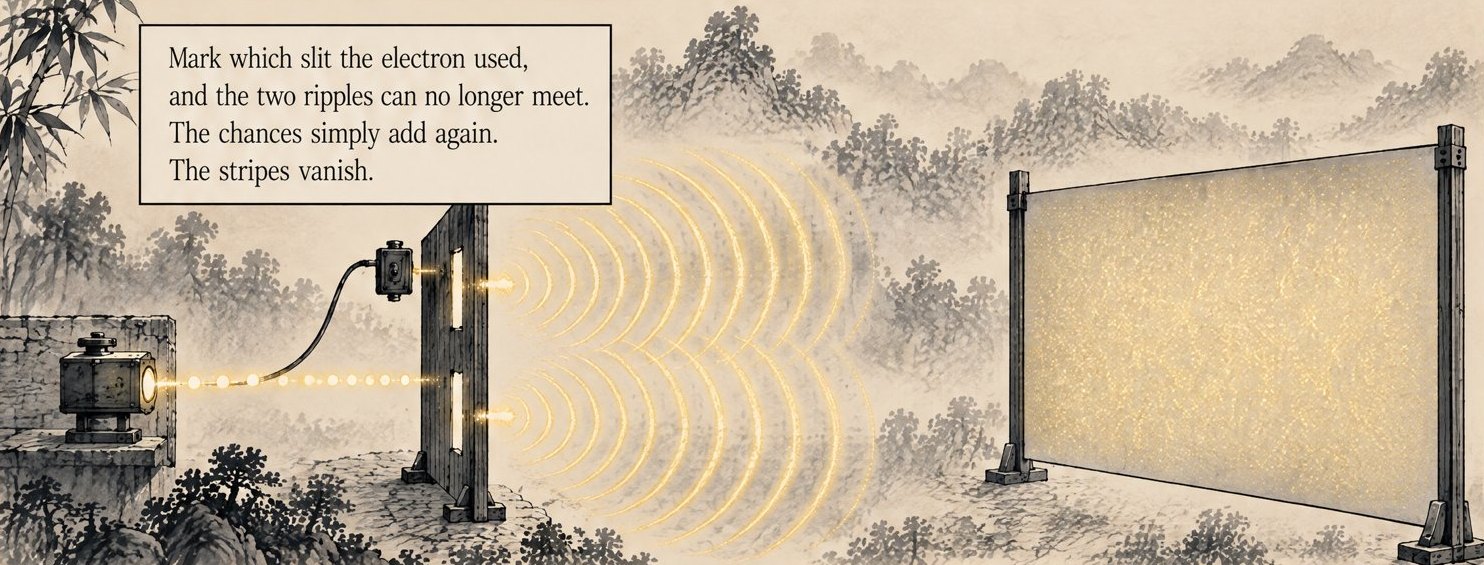
Now mark which slit the electron used. Any tag will do, a scratch or a click saying left or right. The two possibilities are no longer alike, so they cannot cancel, any more than a crest in one pond can cancel a trough in another. The chances simply add again, ¼ + ¼ everywhere, and the stripes vanish. Slide the tag from useless to clear. A useless tag lets you guess the slit right only 50 times in 100, like tossing a coin. Watch the stripes fade.
Chance at each spot, with your tag with the tagordinary adding
Explainers 3 and 4 showed this with a which-path switch. What removes the stripes is difference, not force: one possibility is now tagged left and the other right. The tag only has to exist, and nobody needs to read it. A faint tag, which tells the slits apart only some of the time, leaves fainter stripes, because the parts of the two possibilities that still match can cancel. Berthold-Georg Englert put this trade-off into a formula in 1996. The slider assumes a clean tag, with no extra noise.
Attach tag states t₁ and t₂ to the two paths (overlap taken real and positive):
A clear tag has ⟨t₁|t₂⟩ = 0, so P = |a₁|² + |a₂|². Stripe strength V and how well the tag tells the paths apart, D (a guess is right with chance ½(1 + D)), obey:
Arrows, not just heights
Ripples can also arrive partly out of step, say a quarter of a wave apart. Up or down cannot describe that. Richard Feynman drew each possibility as a little arrow, like a clock hand. Its length is the ripple's height, and its direction shows whether the ripple arrives at a crest, a trough or somewhere in between. To combine two, put them nose to tail. The chance is the length of the total arrow, squared. Turn arrow 2: same way is bright, opposite ways is dark.
Feynman explained this in his 1985 book QED, based on lectures for a general audience. Each way something can happen gets an arrow, like a clock hand that turns as the possibility travels. Add all the arrows nose to tail, then square the length of the total. Because chances come from a square, possibilities interfere only in pairs, so three slits should show no extra three-way effect. In 2010 Urbasi Sinha and colleagues sent light through three slits and found none, to within about a hundredth.
Each arrow is a complex number: a length r and a direction θ.
Squaring leaves only pair terms. Sorkin's three-path test:
Sinha and colleagues bounded ε to less than about 10⁻² of the two-path interference.
Waves first, chances at the end
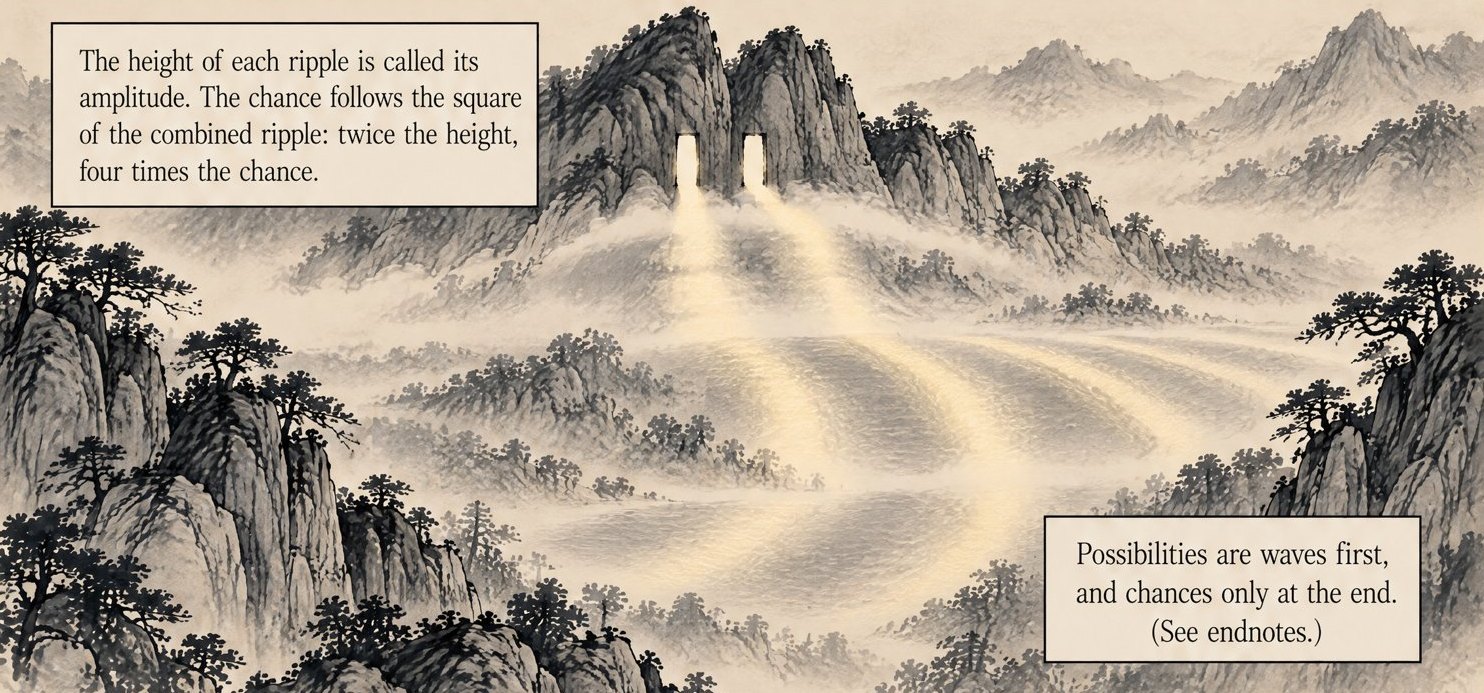
Possibilities are waves first, and chances only at the end. While nothing marks the path, the possibilities travel and meet like ripples, adding or cancelling. Only when the electron lands do you square, and the heights become chances. That one order, add first, square last, is what makes quantum chance different from ordinary chance. Arranged on purpose, the same cancelling lets a quantum computer make wrong answers fade away, on pages 70 and 71.
Born's square rule has passed every test so far, yet nobody can say why nature squares. Some physicists try to derive it from deeper ideas, and others simply take it as a starting rule. The book questions the square itself on pages 27 and 73. What every experiment agrees on is the order: the possibilities add like waves first, and the square comes at the end.
Words to keep
- Amplitude
- The height of a possibility's ripple. It can be up or down, so possibilities can cancel.
- Interference
- Ripples meeting: crest on crest builds up, crest on trough cancels. It makes the stripes.
- Add first, square last
- Add the ripples of all the ways something can happen, then square the total to get the chance.
- Born's rule
- The chance is the height of the combined ripple, squared. Max Born, 1926.