The world takes note. Decoherence
Why a speck of dust never shows stripes: everything that touches it keeps taking notes, and a secret told to the whole world can never be un-told.
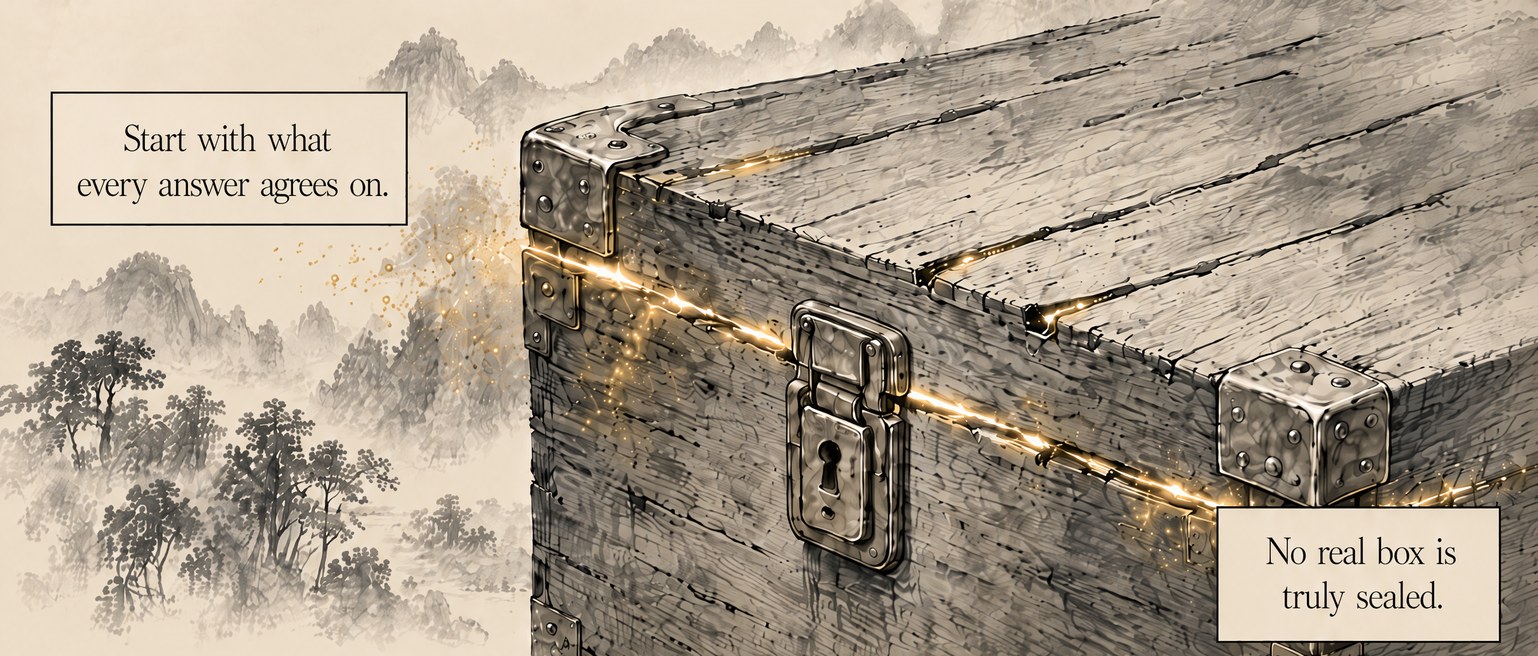
Every bump leaves a record
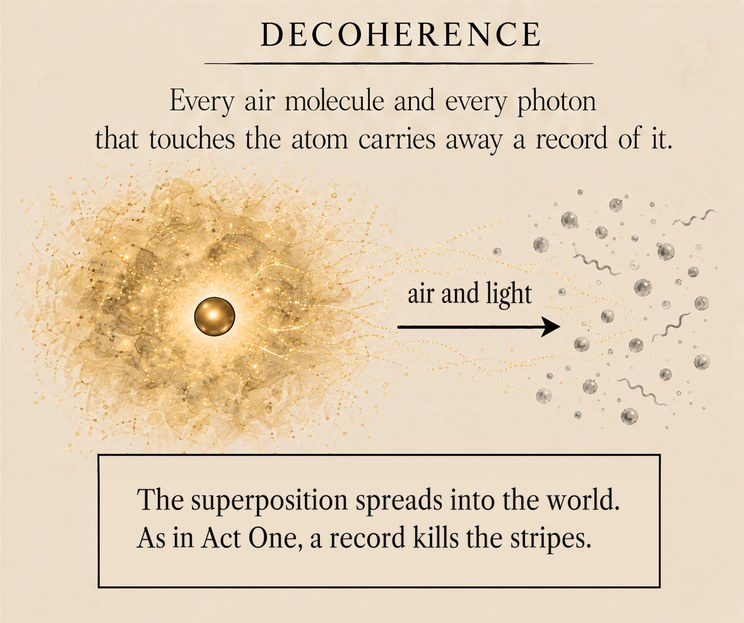
Take a speck of dust in a both-ways wave, in two places at once, like the electron's wave going through both slits. Left alone, its two places could overlap and make stripes. But air molecules, the tiny bits that air is made of, keep bouncing off it. Each one flies off a little differently depending on where the speck was, so it carries a record. It is like a secret told to more and more people. Every molecule that hears it weakens the stripes. This fading is called decoherence. Add bounces.
Molecules bouncing off the speck the speck, in two placesa molecule, drawn once for each place
The stripes it could make with its both-ways wavea plain smear
Drag the slider or press the button, and pick how much each bounce gives away. Notice that every bounce weakens the stripes a little more, and one bounce that tells the whole secret wipes them out at once.
Each bounced molecule becomes entangled with the speck. Like two coins that each land at random but always agree, the two can now only be described together, so the "both" is shared with every molecule flying off. H. Dieter Zeh first described this in 1970, and Wojciech Zurek, Erich Joos and others developed it in the 1980s. In 1996 Serge Haroche's group in Paris watched it happen. A microwave field of a few photons, put into two states at once, lost its quantum signature, and faster when the two states were more different.
If the two ways a molecule can fly off overlap by a fraction s, each bounce multiplies the stripe contrast (the visibility V) by s:
With s = 0.9, ten bounces leave 0.9¹⁰ ≈ 0.35. If bounces arrive at random at a rate Γ, the interference term shrinks smoothly in time:
You cannot un-tell a secret
To bring the stripes back, every record would have to go. You would need to catch every molecule that bounced off and undo its bounce exactly. Miss a single one and the stripes stay gone. With a single record it can be done: wipe it out completely and the stripes return, as the book shows on page 14. With the air of a room, never. A secret told to the whole world cannot be un-told. Pick how many molecules bounced off, then gather them back.
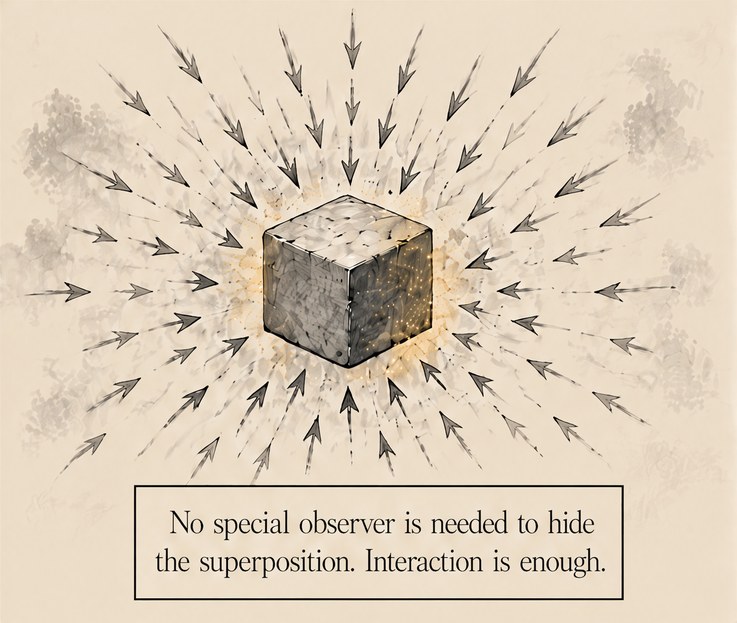
Notice that the stripes come back only when the very last molecule is home. Each bounce here tells the whole secret, as an air molecule does for the speck in the book. A speck in air is hit about a billion billion times every second. Undoing just one second of that, one molecule each second, would take about 30 billion years, more than twice the age of the universe.
Nothing in the equations forbids undoing it all. Every molecule's motion would have to be reversed exactly, and so would every molecule it has bumped into since. In air a molecule hits another in less than a billionth of a second, so the secret keeps spreading. That is why the book says the superposition leaks rather than stops. The eraser on page 14 works because there is a single record to destroy, and it leaves the other question open: why each photon lands in one place.
With full records (s = 0), undoing k of N records leaves V = 0^(N − k), which is 1 only when k = N. One second in air holds about 10¹⁸ full records:
How fast the world takes note
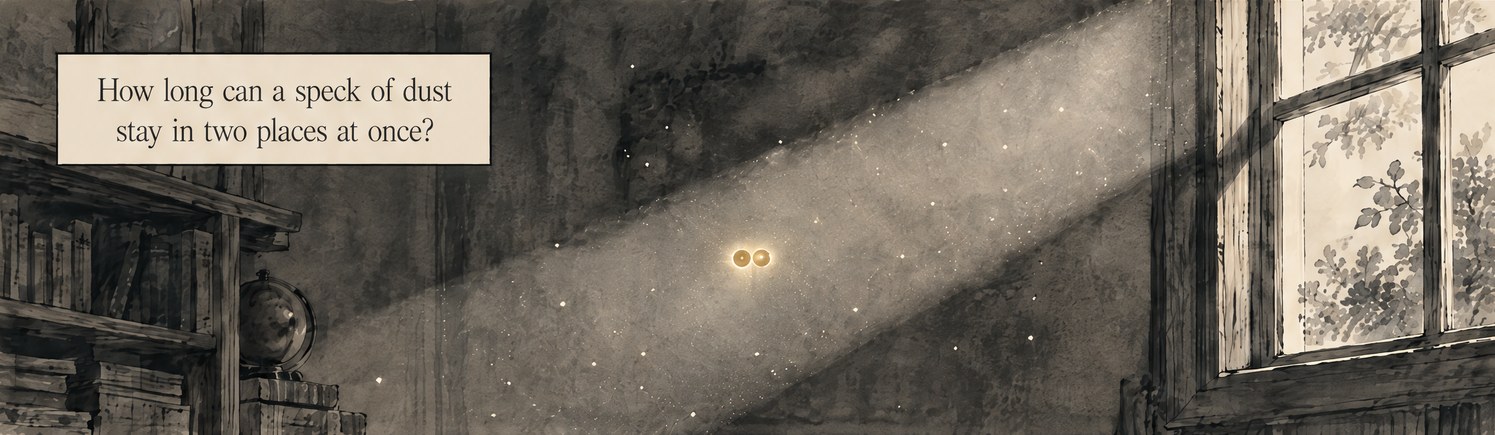
Take a speck a hundredth of a millimetre across, as the book does, in two places one speck-width apart. How long its both-ways wave lasts depends on its environment, everything around it that can touch it. In deep space, lit only by the afterglow of the Big Bang, faint old light that fills all space, it lasts about a second. In sunlight with no air, a few trillionths of a second. In air, about a billionth of a billionth. Each rung of the ladder is ten times shorter than the one above. Climb down.
A speck a hundredth of a millimetre across still both waysthe world has taken note
Each rung is a waiting time. Notice where each column turns gold: you would have to look that soon to catch the speck still both ways. In air that is eighteen rungs below one second. Rough values, as in the book: about a second, a few trillionths (drawn as three), and a billionth of a billionth.
The speck is barely visible, yet it holds tens of trillions of atoms. The book's numbers are rough estimates for the speck in two places one speck width apart. At that distance a single air molecule, or a single photon of sunlight, records where it is, so the both-ways wave lasts about as long as the wait between hits. About a billion billion air molecules hit it each second, and a few hundred billion photons of sunlight. Standard tables give a far smaller figure for this speck in air, about 10⁻³¹ seconds, but that comes from a formula meant for hits that each reveal only a little. The stripes cannot go faster than the hits arrive, so for two places one speck-width apart the book's billionth of a billionth is the sounder figure.
When the separation Δx is much larger than the wavelength of what hits the speck, every hit is a full record, and τ_D is simply the time between hits:
The afterglow's waves, about a millimetre long, are far longer than Δx = 10 µm, so each photon tells very little and the rate grows as Δx²: 1/τ_D = ΛΔx², about 1 s⁻¹. In air, light crosses c·τ_D ≈ 3 × 10⁸ m/s × 10⁻¹⁸ s = 0.3 nm.
When, not why
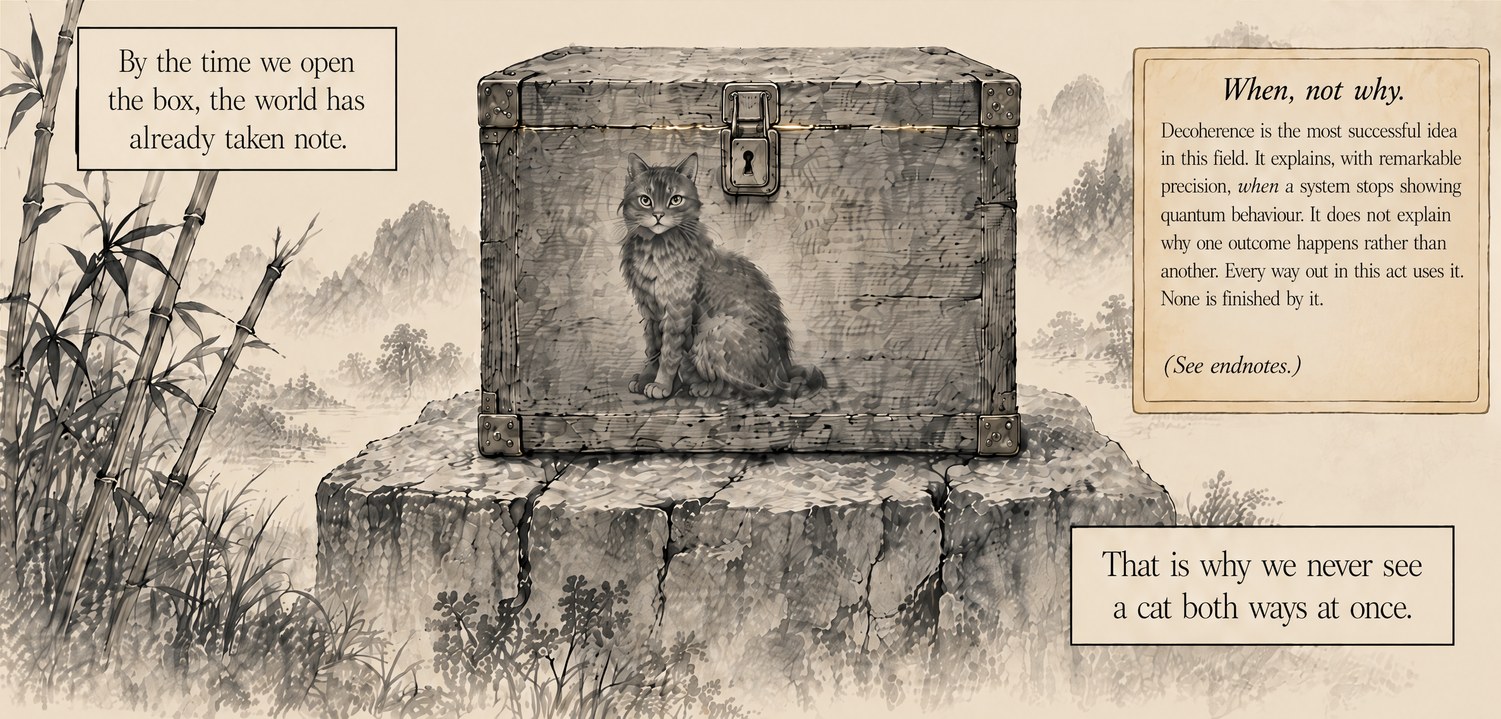
Decoherence tells us when a thing stops showing its both-ways side: once the world has taken note. Then the two places can no longer overlap, so there are no stripes, and the speck acts like an ordinary either-or. But decoherence never says which place you will find. The chances stay fifty-fifty however many records pile up. Why we see one result is still argued. The book follows four rival answers, its four ways out, and all four accept decoherence. Add records, then look.
Decoherence is not one of the ways out. It is ordinary quantum mechanics applied to a thing together with its surroundings, which is why all four accept it. Specialists broadly agree with the book's verdict. After decoherence the possibilities can no longer interfere, yet the mathematics still holds both, now shared with the surroundings. John Bell objected that this settles matters only "for all practical purposes". Every way out uses decoherence. None is finished by it.
On its own, the speck is described by a small table of four numbers. The corners are the chances, and they never change. The cross terms carry the stripes, and decoherence shrinks them:
Decoherence turns the both-ways wave into something that looks like a fair coin. It never turns ½ and ½ into 1 and 0.
The main enemy of quantum computers
A quantum computer works with qubits. An ordinary computer's bits are each a 0 or a 1. A qubit can be a both-ways wave of 0 and 1, and shows just one of them when checked. Every stray molecule, flash of light or jiggle of heat takes a record and spoils it. So engineers do what the speck would need: pump out the air, shut out the light, and cool everything, even colder than deep space. They cannot stop the world taking note, only delay it. Add the shields one by one.
Notice that each shield takes away one kind of hit, and the both-ways wave lasts millions of times longer. It still leaks out in the end. Qubits fight the same fight. They return on book page 69, and the last explainer, How wrong answers cancel, shows what a quantum computer does in the time the world is kept out.
A thing can even give itself away. In 2004 a group in Vienna heated large molecules with lasers to above 3,000 kelvin before sending them through gratings. The stripes faded as the molecules' own glow began to carry a record of their path. Shield something well enough and quantum behaviour returns in larger things, as Act Three of the book shows. In a quantum computer the struggle never ends: every qubit slowly leaks, so the machine must finish its work, or correct its errors, before the world takes note.
The rates of every kind of hit simply add, and each shield removes one term:
Room air: about 10¹⁸ s⁻¹. A perfect vacuum in sunlight: about 3 × 10¹¹ s⁻¹. Dark and as cold as deep space: about 1 s⁻¹. Any gas left in a real vacuum adds its own hits.
Why the world looks definite
Nothing switches the both-ways wave off. It spreads into the air and the light until no one could ever gather it back. That is why the world around you looks definite: it is never left alone. Shield something well enough and quantum behaviour comes back, even in things far bigger than an atom. Next, the book follows two particles that share one both-ways wave, and asks whether they carried secret instructions all along.
The line between quantum and classical is not a fixed size. It depends on isolation, which is why quantum experiments happen in vacuum chambers and in fridges colder than deep space. Decoherence still leaves two things open: where the line between a thing and its surroundings comes from, and why one result appears. Those questions run through the rest of the book.
Words to keep
- Decoherence
- The fading of a both-ways wave's stripes as its surroundings take records of it. Nothing is destroyed. The both-ways wave leaks out into the world.
- Environment
- Everything around a thing that can touch it: air, light, heat.
- Record
- Any lasting trace of where something was or which way it went, whether or not anyone ever reads it.