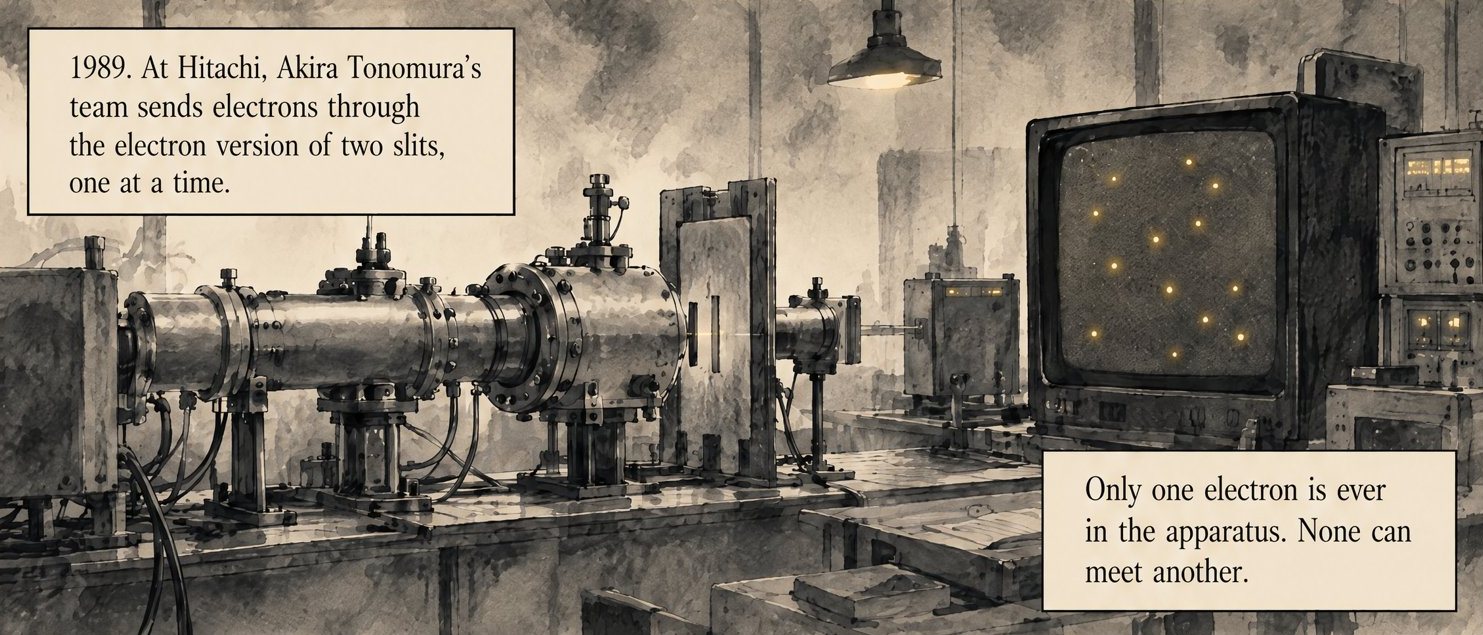
One at a time. Tonomura, 1989
Fire electrons at two slits, one by one. Each lands as a single dot, yet together they draw the stripes of a wave.
Fire one electron
An electron gun fires electrons at a wall with two thin slits. Behind the wall, a screen lights up wherever an electron lands. Fire one. It makes a single sharp dot in one place, like a tiny pellet, never a smear. Fire again, and the next dot lands somewhere else. Nobody can say in advance where the next one will go. Tap the screen to guess where it will land, then fire. Notice how rarely the guess is close.
Slits fine enough for electrons are very hard to make. Tonomura's team used an electron biprism instead: a charged wire thinner than a thousandth of a millimetre, which lets each electron pass on either side and bends the two ways together. It plays the part of two slits. Their detector caught almost every electron that arrived, each as one sharp dot. Where a dot lands cannot be predicted. On the standard view of quantum physics, not even nature knows in advance. Some views, met in Act Two of the book, disagree.
Each landing spot x is drawn at random from the probability density, which adds up to one over the whole screen:
Even the best possible guess is close only about one time in five.
Fire thousands, and stripes appear
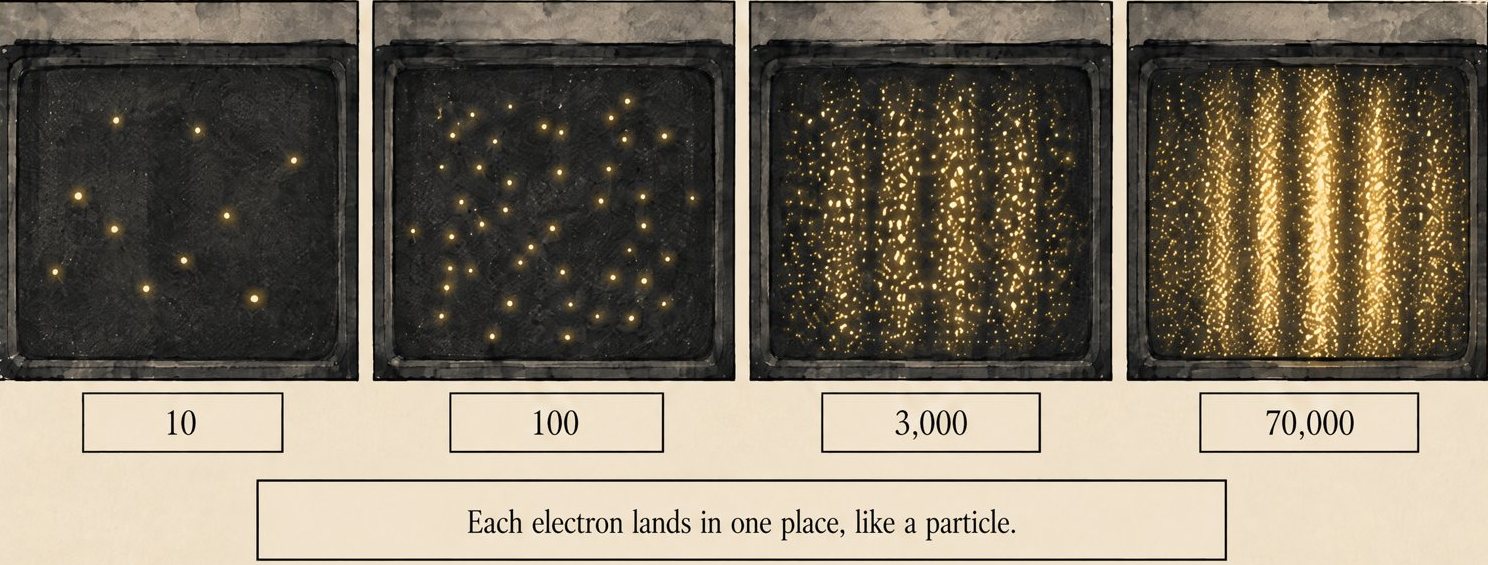
One dot tells you nothing. So fire electrons by the thousand, still one at a time. Each lands as a single dot at a random place, yet the dots crowd into some places and avoid others. Slowly, bright and dark stripes appear. They are the stripes of a wave, like the ones ripples made in explainer 3. Press start, or tap one of the book's screens: 10, 100, 3,000 or 70,000 electrons. Notice that stripes show only once there are thousands of dots.
Dots counted along the screen dots so farwhere endless dots would go
Tonomura's team at Hitachi recorded this build-up as a film and published it in 1989, with stills after 10, 100, 3,000, 20,000 and 70,000 electrons. The book's four screens follow those stills. The paper says they kept the rate to about 1,000 electrons a second, slow enough to be one at a time yet fast enough for the stripes to form in a reasonable time, about 20 minutes. A team in Bologna, Merli, Missiroli and Pozzi, had done a similar experiment in 1974.
A strip of the screen that expects μ dots gets about μ give or take √μ, so the wobble shrinks as dots pile up:
A hundred times more dots make the bars ten times smoother.
The both-ways wave
Each electron travels as a wave of possibilities, a wave that says where it could turn up. That wave goes through both slits at once. Physicists call this both-ways wave a superposition. The ripples from the two slits overlap: crest on crest makes the wave tall, crest on trough cancels it. Then the electron is detected and shows up as one dot. The chance of a dot is the wave's height, squared: double the height, four times the chance. Send one, then slide the spot.
One electron's wave, seen from above height squared: the chanceheight of the wave
This wave is not made of anything you could touch. It is a wave of possibilities, and its height at each place sets the chance of finding the electron there. Max Born proposed squaring the height in 1926. What happens at the moment of detection, when the spread-out wave gives way to one dot, is still argued. Some physicists say the wave really shrinks to a point, others that it never does. Explainer 5 shows why the two slits' heights must be added before squaring.
Each slit sends on its own part of the wave, ψ_L and ψ_R. They add, and the chance is the square of the total:
Every moving thing has a wavelength set by its momentum p, as Louis de Broglie proposed in 1924:
Tonomura's electrons, sped up by 50,000 volts, had λ ≈ 5.4 × 10⁻¹² m, about 100,000 times shorter than green light. The picture uses soft-edged (Gaussian) slits, with the wave spread by the Schrödinger equation and enlarged for the eye.
Watch the slits, and the stripes vanish
Now give each electron a tag that records which slit it went through, like a label saying “left” or “right”. The tag does not need to push the electron at all. Once there is a record of the path, the wave can no longer overlap with itself, and the stripes vanish. Not into two neat bands behind the slits, as cartoons show: each slit still spreads its electrons wide, so they land in one broad, smooth band. Switch the tag on and off, and watch the stripes come and go.
Dots counted along the screen no record: stripeswith a record: one broad band
Any lasting record works: a click, a scratch, a changed atom, whether or not anyone ever reads it. In 1998 a team at the Weizmann Institute in Israel put a which-path detector beside a tiny ring-shaped electron circuit with two routes, the electron version of two slits. The more clearly the detector could tell the routes apart, the fainter the stripes. A record that is only partly readable leaves partly faded stripes. Explainer 5 shows why tagged possibilities can no longer cancel.
No record: add the heights, then square. A perfect record: square each, then add.
The difference is the interference term 2 Re(ψ_L* ψ_R), which draws the stripes. A partial record multiplies it by the overlap of the two record states, whose size lies between 0 and 1.
No electron ever meets another
Could the stripes come from electrons jostling each other on the way, like a crowd squeezing through two doors? Not here. In Tonomura's experiment there was almost never more than one electron inside the instrument. Almost every electron landed long before the next one set out, so it had nothing to meet but itself. Yet the stripes still built up, dot by dot. Slide the rate. At Tonomura's rate, about 1,000 a second, the electrons are on average more than 100 km apart.
The electrons, as if they flew in a line
From the book: “Only one electron is ever in the apparatus. None can meet another.”
The 1989 paper gives the numbers. From source to screen the instrument was 1.5 m long, and electrons arrived about 1,000 a second. The paper puts the average gap between one and the next at 150 km. Worked out from their exact speed, this page gets about 124 km. Each electron's wave was only about a thousandth of a millimetre long, so two could almost never overlap. At rates from 200 to 5,000 electrons a second, the stripes came out equally strong, within the team's 10 percent error.
A 50,000-volt electron moves at v ≈ 0.41c ≈ 1.24 × 10⁸ m/s, and crosses L = 1.5 m in τ = L/v ≈ 12 ns. At a rate r, the gap is v/r and the average number inside is rτ:
The paper's 150 km matches the rounder speed c/2. If electrons set out at random moments, the chance that one shares its trip with another is 1 − e^(−2rτ).
Each electron interfered with itself
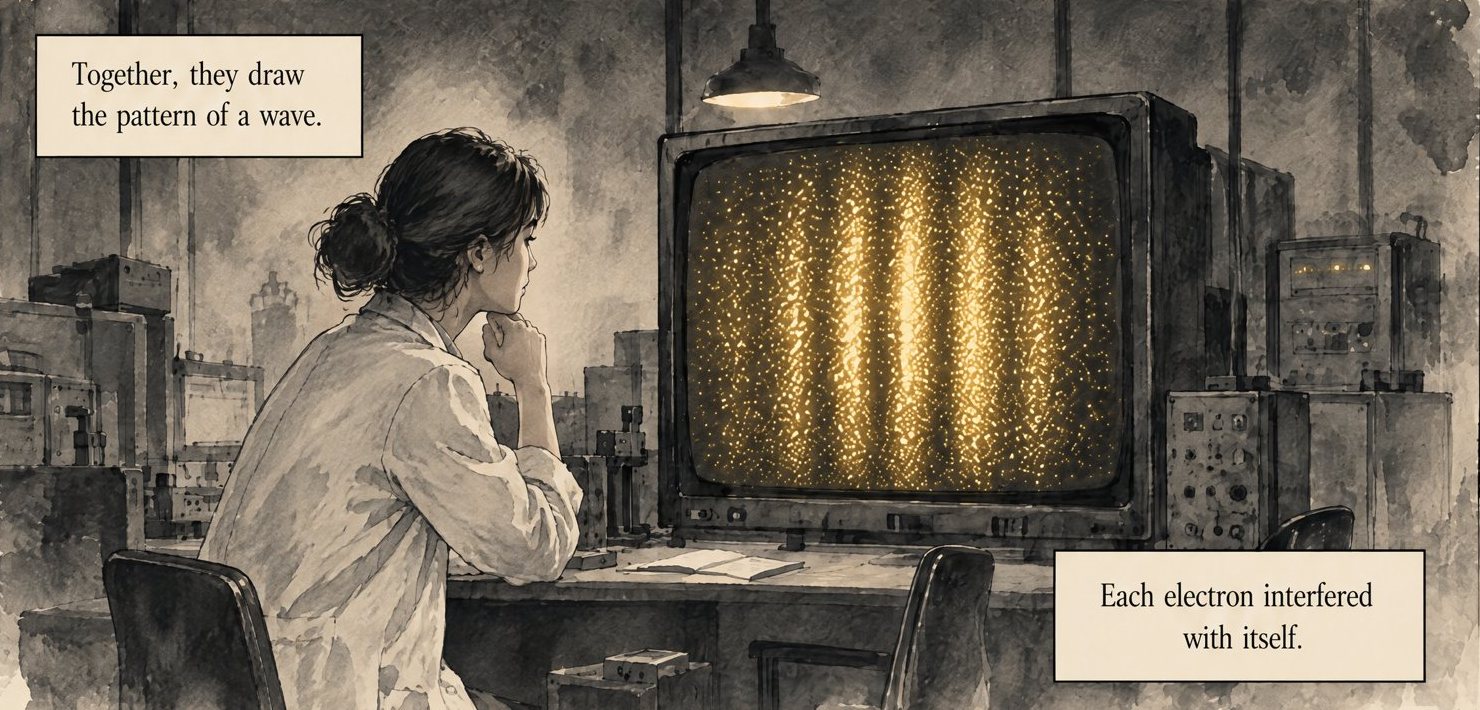
So an electron is neither a tiny pellet nor an ordinary wave. On its way it acts like a wave that goes both ways and overlaps with itself. When it is detected it shows up as one dot, at a place set by chance. One electron makes no pattern. Thousands, sent one at a time, draw the stripes of a wave.
In his 1930 textbook Paul Dirac said much the same of light: each photon interferes only with itself. In 2002, readers of Physics World voted the double-slit experiment with single electrons the most beautiful experiment in physics. The wave side of electrons is useful too: it is what lets electron microscopes see single atoms. Larger things do it as well. On page 65 of the book, molecules of sixty atoms make stripes of their own.
Words to keep
- Superposition
- The both-ways wave. An electron's wave of possibilities going through both slits at once.
- Detection
- Finding the electron. It always shows up as one dot, in one place.
- Probability
- The chance of something happening. For an electron, the height of its wave at a spot, squared.