Light in lumps. Einstein and Bohr
Why dim violet light can do what bright red light cannot, and why glowing hydrogen shines in just a few exact colours.
One coin, one electron
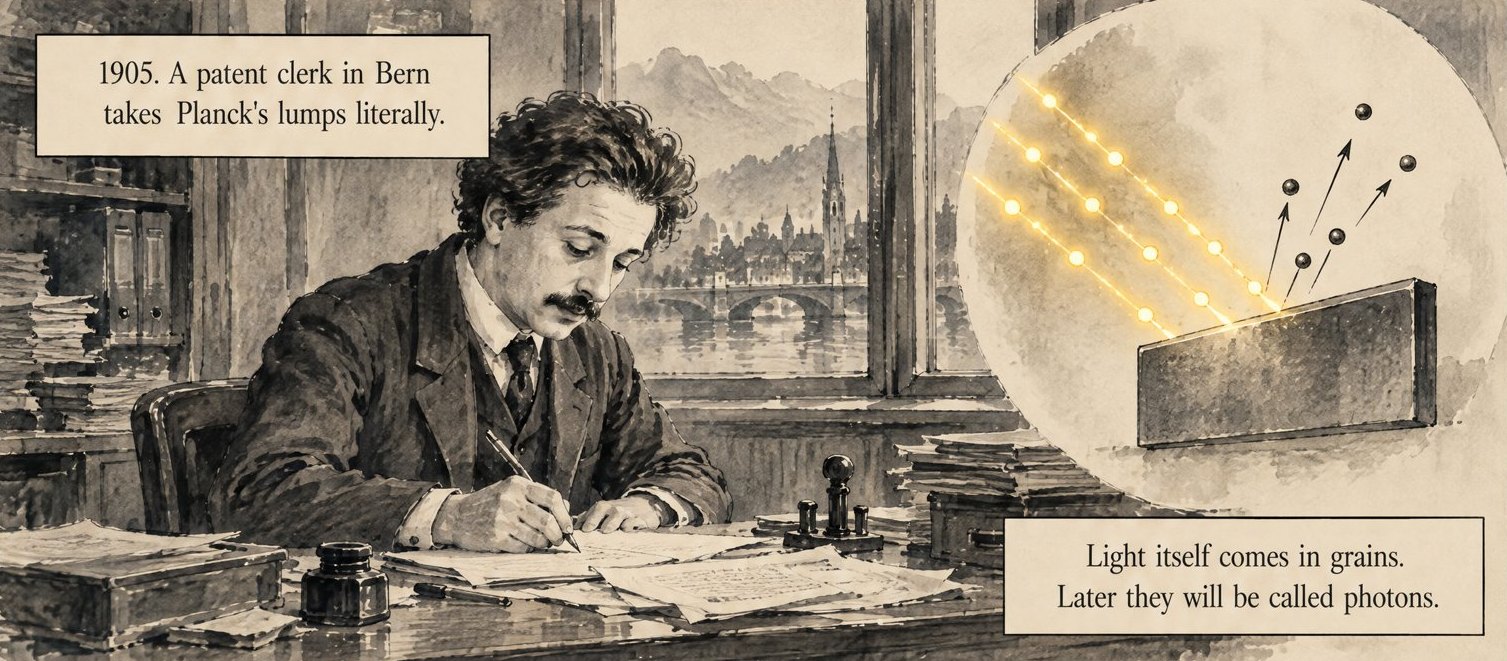
Einstein took Planck's coins literally. Light itself arrives as single coins, the book's grains, later called photons. When light hits a metal, each coin meets one electron, a tiny charged speck found in every atom. Electricity in a wire is electrons on the move. To escape the metal, an electron must pay an exit fee, and it can spend only one coin. A pile of small coins cannot pay together. Slide the colour, then the brightness. Notice that from yellow to red no electron escapes, however bright the light.
One coin against the exit fee pays the feeleft over for speed
The metal is sodium. Its exit fee is about 2.3 eV, where an eV (electronvolt) is a tiny unit of energy sized for single particles. The exact fee depends on how clean the surface is. So the cut-off falls in the green, near 540 nm. The drawing is slowed right down, and every coin meets an electron.
Einstein finished his paper on light quanta in March 1905, aged 26, while working at the patent office in Bern. Experiments had shown beyond doubt that light is a wave, so grains of light looked absurd. Yet the clues were there. Heinrich Hertz noticed in 1887 that ultraviolet light helps sparks leap from metal, and in 1902 Philipp Lenard found that brighter light freed more electrons but not faster ones. In a real metal most coins are simply swallowed, and only a small share free an electron. Below the cut-off, none ever do. Sodium is an easy metal. For zinc or copper the fee is so big that even violet fails, and only ultraviolet works.
One coin of light carries E = hν. The fastest electron keeps what is left after the exit fee W, which physicists call the work function:
Speed from energy is v = √(2E/m), so 0.80 eV gives about 530 km/s. A 1 milliwatt violet beam carries about 2 × 10¹⁵ coins a second.
Bright red, dim violet
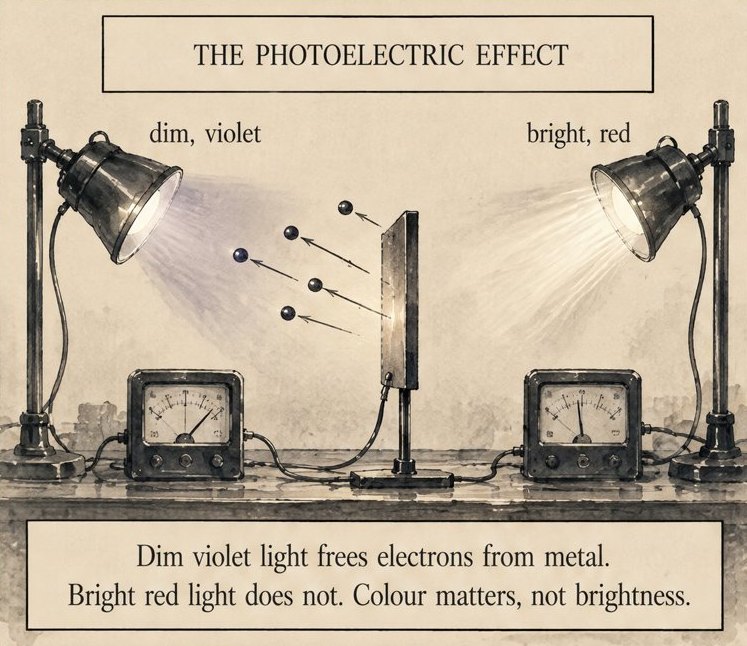
The old wave idea said brightness is what counts. A brighter wave shakes the metal harder, as bigger ripples rock a boat harder, so bright light of any colour should free electrons, and faster ones. Coins say the opposite. A bright red lamp sends a flood of small coins, and not one is big enough. A dim violet lamp sends only a few, but each one pays the fee alone. Try the book's two lamps, then the others. Notice the meter: colour decides whether electrons come out, brightness only how many.
Robert Millikan, an American experimenter, set out to test Einstein's formula with great care. By 1916 he had confirmed it and measured h along the way, yet he still doubted that light was made of grains. Einstein's Nobel Prize, the one for 1921, awarded in 1922, cited his law of the photoelectric effect, not relativity. The grains got their name, photons, in 1926 from the chemist Gilbert Lewis.
Brightness sets how many coins arrive each second, and so how many electrons leave. It does not change the top energy:
Red at 700 nm: hν = 1.77 eV, below W, so none. Violet at 400 nm: hν = 3.10 eV, so E_max = 0.80 eV.
The atom's staircase
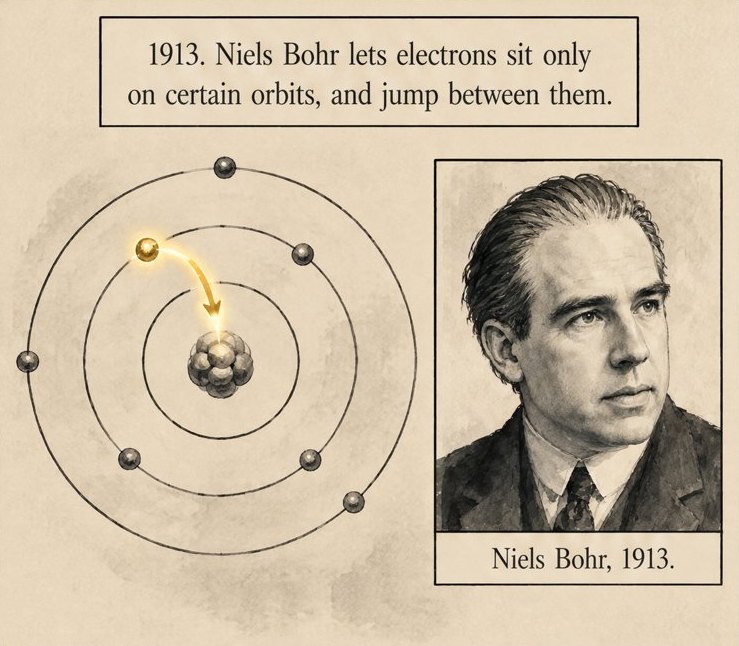
In 1913 Niels Bohr gave the atom a staircase. In hydrogen, the simplest atom, the one electron can stand only on certain steps, never in between. When it drops to a lower step, a quantum jump, it gives out the energy it lost as one coin of light. A big drop makes a big coin, towards violet, and a small drop a small coin, towards red. Tap a jump: 3 → 2 means from step 3 down to step 2, and step 1 is the bottom. Notice that two jumps give coins the eye cannot see.
In glowing hydrogen, bumps between atoms keep lifting electrons back up the stairs, so each jump here starts from the step you chose.
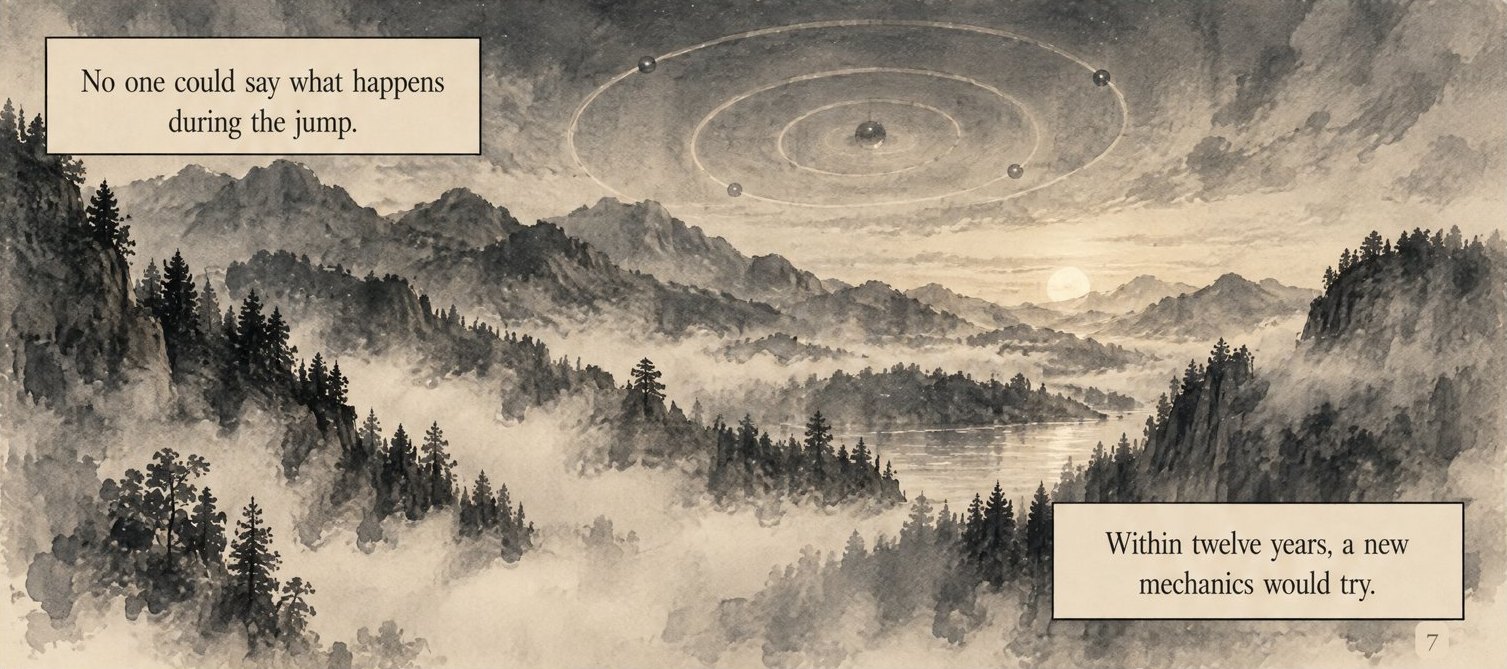
Bohr, a 27-year-old Dane, published his atom in 1913. Glowing hydrogen was known to shine in only a few sharp colours, and in 1885 a Swiss schoolteacher, Johann Balmer, had found a simple number pattern in them without knowing why. Bohr's steps explained the pattern exactly. His mentor Ernest Rutherford wrote back asking how the electron knows in advance where it is going to stop. Nobody could say what happens during the jump.
Step 1: −13.6 eV. Step 2: −3.40 eV. Step 3: −1.51 eV. Freeing the electron from step 1 costs 13.6 eV.
Every atom has a barcode
A prism spreads the light of a hot solid into a smooth rainbow, a spectrum with every colour at once, as in Planck's kiln. Glowing hydrogen gives only a few sharp lines, one for each kind of jump. Each jump you made above left a line in your strip. Other elements have other staircases, so other barcodes, and starlight carries them too. That is how we know what stars are made of. Compare your strip with the lights below. Notice the gold marks where your hydrogen lines match dark lines in sunlight.
Your barcode, from the jumps you made
Compare with: hydrogen matches one of your lines
In 1814 Joseph von Fraunhofer mapped hundreds of dark lines crossing sunlight. In 1859 Gustav Kirchhoff and Robert Bunsen showed that each element glows in its own lines, and that a cooler gas in front of a hot glow swallows the very same colours. So the dark lines in sunlight are barcodes of the Sun's gases. In 1868 astronomers saw a yellow line at the Sun's edge that matched nothing known. They named it helium, after the Greek word for the Sun, and it was found on Earth only in 1895.
Jumps down to step 2 (the Balmer series) crowd towards 4/R ≈ 365 nm. Jumps to step 1 (Lyman) are ultraviolet, and jumps to step 3 (Paschen) are infrared.
Orbits that were not paths
Bohr's old model pictured each step as a ring, with the electron circling the centre like a planet round the Sun. The steps were right, but the rings were not. In the full theory, from 1925 onward, the electron has no path at all. Each step is a cloud of places where it might be found. For the cloud drawn here, the most likely distance is just where Bohr drew his ring. Switch between ring and cloud on each step. Notice that each step's energy is the same in both pictures.
Bohr's ringelectronplaces it might be foundBohr's ring
How far from the centre
The dot at the centre is the nucleus, the atom's tiny heavy core. Each step is zoomed to fit, so check the scale bar.
Bohr's model gave no cause and no timing for a jump, and it failed for every atom with more than one electron, even helium. In 1925 and 1926 Werner Heisenberg and Erwin Schrödinger built the new mechanics, which the book reaches on page 9. It swapped the rings for clouds of possibilities. The jumps are real, though. In 1986 three laboratories watched single trapped ions jump, their glow switching on and off. In 2019 a team at Yale caught a jump in an artificial atom mid-flight and reversed it.
Bohr's ring for step n has radius r_n = n²a₀, with a₀ = 0.0529 nm. The full theory keeps E_n = −13.6 eV / n². Drawn here is the roundest cloud on each step (l = n − 1), whose chance of each distance is
Words to keep
- Photon
- One coin of light. Its size is set by its colour: violet coins are big, red ones small.
- Electron
- A tiny charged particle found in every atom. Electricity is electrons on the move.
- Quantum jump
- An electron's sudden move from one step of its atom's staircase to another. A drop sends out one photon of one exact colour.
- Spectrum
- The colours in a light, spread out in rainbow order. A hot solid gives a smooth one, a glowing gas a barcode of lines.