Two slits. Stripes mean waves
Shine light through two narrow slits and the far wall fills with stripes. Find out which slit the light took, and the stripes are gone.
Ripples meet
Drop two stones in a pond and two sets of ripples spread out and cross. Where a crest, a high point, meets a crest, the water rises twice as high. Where a crest meets a trough, the low point between crests, they cancel and the water stays flat. This adding and cancelling is called interference. Two slits in a wall do the same to one wave, since each slit sends out its own ripples. Mark the calm lines where the water stays flat, then change the gap and the wavelength.
Every kind of wave does this, and it has a name: interference. Each calm line follows the points where one ripple has travelled exactly half a wave further than the other, or one and a half, or two and a half. There a crest always meets a trough. Noise-cancelling headphones use the same trick with sound. A microphone hears the noise around you, and the headphone plays it back flipped, troughs for crests, so the two cancel in your ear.
At a point a distance r₁ from one slit and r₂ from the other, the two ripples add:
calm: r₂ − r₁ = (m + ½)λ
m = 0, ±1, ±2, …
The difference r₂ − r₁ is always less than the gap d, so the number of calm lines is twice the count of ½, 1½, 2½, … that are smaller than d/λ. The ripples here weaken as 1/√r, as circular waves on water do.
Stripes on the wall
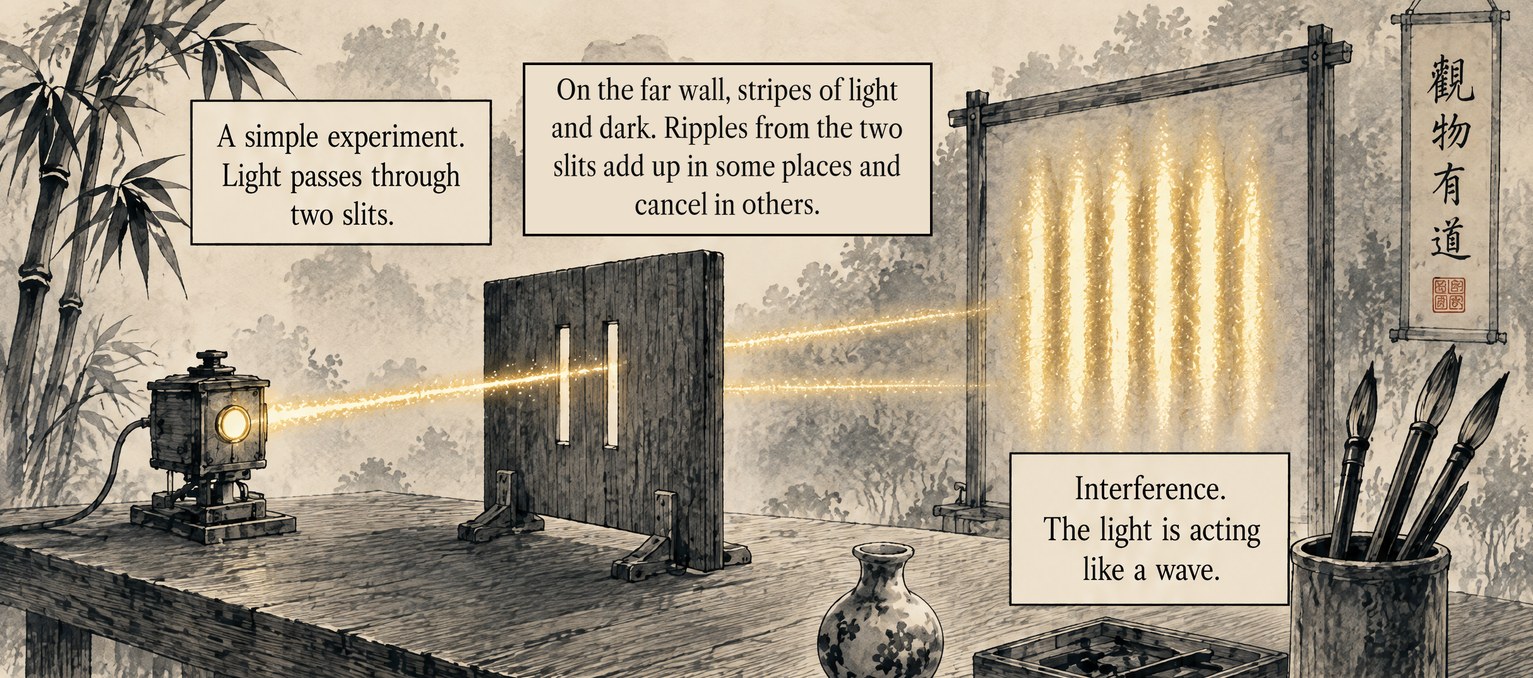
Light does the same, with ripples far too small to see. Most spots on the wall are a little further from one slit than the other, so that slit's ripples arrive a little behind. Where they arrive in step, crest with crest, there is a bright stripe. Where they arrive out of step, crest with trough, there is a dark one. Pick a colour and a gap between the slits. Notice that longer waves and closer slits give wider stripes. Tap the wall to see how far one wave lags.
Brightness across a wall 1 metre behind the slits worked out from the two waves
From the book: “On the far wall, stripes of light and dark. Ripples from the two slits add up in some places and cancel in others.” Here the slits are 0.05 mm wide, about the width of a thin hair.
Thomas Young first showed light making stripes, between about 1801 and 1803. He let sunlight into a dark room through a pinhole, split the thin beam in two and saw bands where the two halves overlapped. From the spacing of the bands he worked out how long light waves are, and found them tiny, less than a thousandth of a millimetre. Many physicists stayed doubtful until Augustin Fresnel's work in France in the 1810s.
Bright stripes sit where the extra distance is a whole number of wavelengths. On a wall a distance L away they are spaced Δy apart:
The full brightness, for slits of width a (here a = 0.05 mm and L = 1 m):
× sinc²(π a sin θ / λ)
sinc x = sin x / x
Close one slit
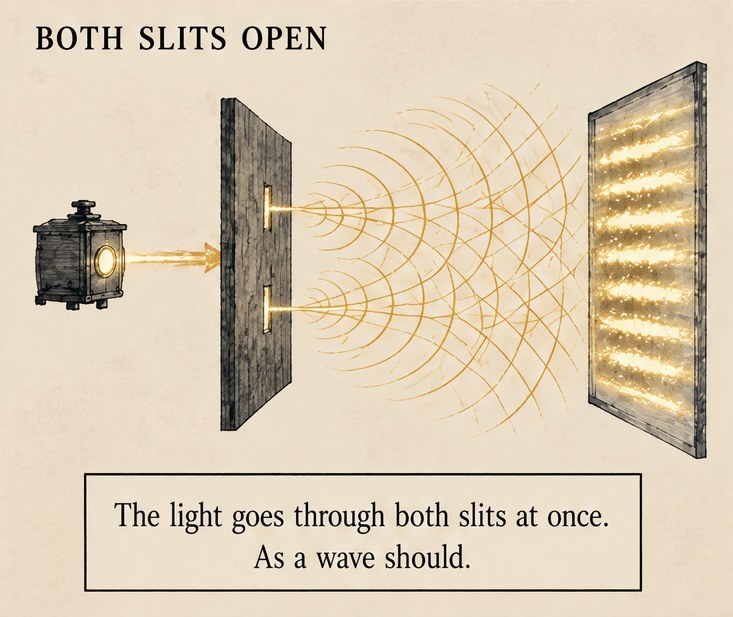
Cover one slit and the stripes disappear, leaving one broad, soft glow. Now open the second slit again. More light gets through, yet some places on the wall go dark. If light were just a spray of pellets, a second opening could only add more. Waves can cancel, so a dark stripe is where the ripples from the two slits undo each other. Yet light also comes in coins. How single coins still make stripes is the next explainer's puzzle. Try one slit and both, then tap a spot on the wall.
both slitsone slit
With both slits open, the bright stripes are not twice as bright as one slit's glow but four times, and the dark stripes get nothing. Averaged over the wall it comes to exactly twice, so no light is lost or made. It is only moved. For water waves none of this is strange. For light it is, because light also comes in coins, and a single coin cannot be half cancelled. Page 12 sends particles through one at a time to see what happens.
Waves add their heights first, and brightness is the height squared. With a wave of height E from each slit:
out of step: (E − E)² = 0
average: 2E²
Two slits give twice one slit's light overall, but four times at a bright stripe and nothing at a dark one.
Tag the path
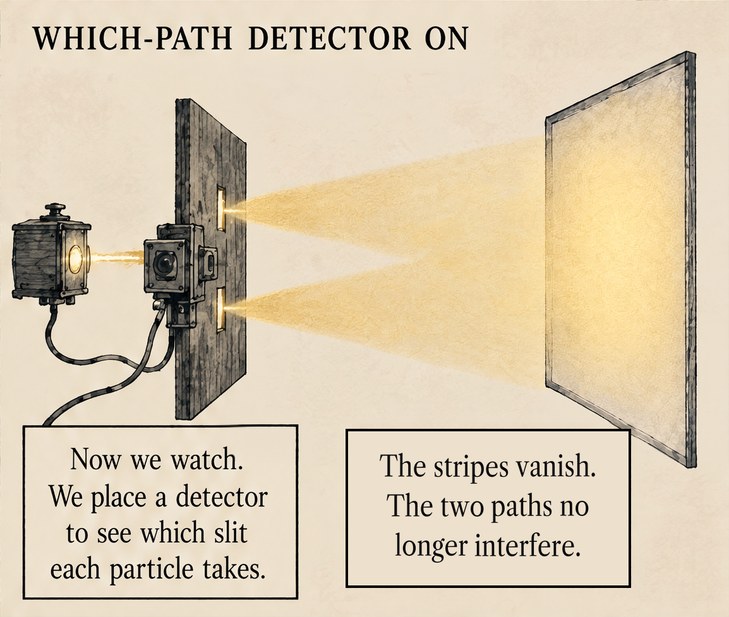
Now put a tag on each slit, a mark on every passing coin of light that says left or right. Nothing pushes the light off course. The tag is simply a lasting trace of the path, a record. The stripes vanish, and the wall shows only the two single-slit glows added together. Make the tag harder to read and faded stripes come back. Switch the tag on, then slide how readable it is. Notice that the more the tag tells, the fainter the stripes.
what the wall showstwo glows added
This is not a clumsy detector bumping the light. In 1998 Gerhard Rempe's group in Germany sent atoms along two paths and tagged each path by gently changing a state inside the atom, far too gently for any kick to matter. The stripes still vanished. For light, the tag can be a polarising filter on each slit, like the ones in some sunglasses, set to let through different directions of wiggle. The book draws the result as one even glow (pp. 11, 14 and 17). Cartoons often show two neat bands behind the slits instead, but with slits as narrow as these each glow spreads so wide that the two overlap into one.
V is the stripe contrast and D how well the tag tells the two paths apart. With tag states t_L and t_R:
δ = 2π d sin θ / λ
V = |⟨t_L|t_R⟩|
D² + V² ≤ 1 always (Englert, 1996)
A best guess of the slit from the tag is right with chance (1 + D)/2.
A first rough conclusion
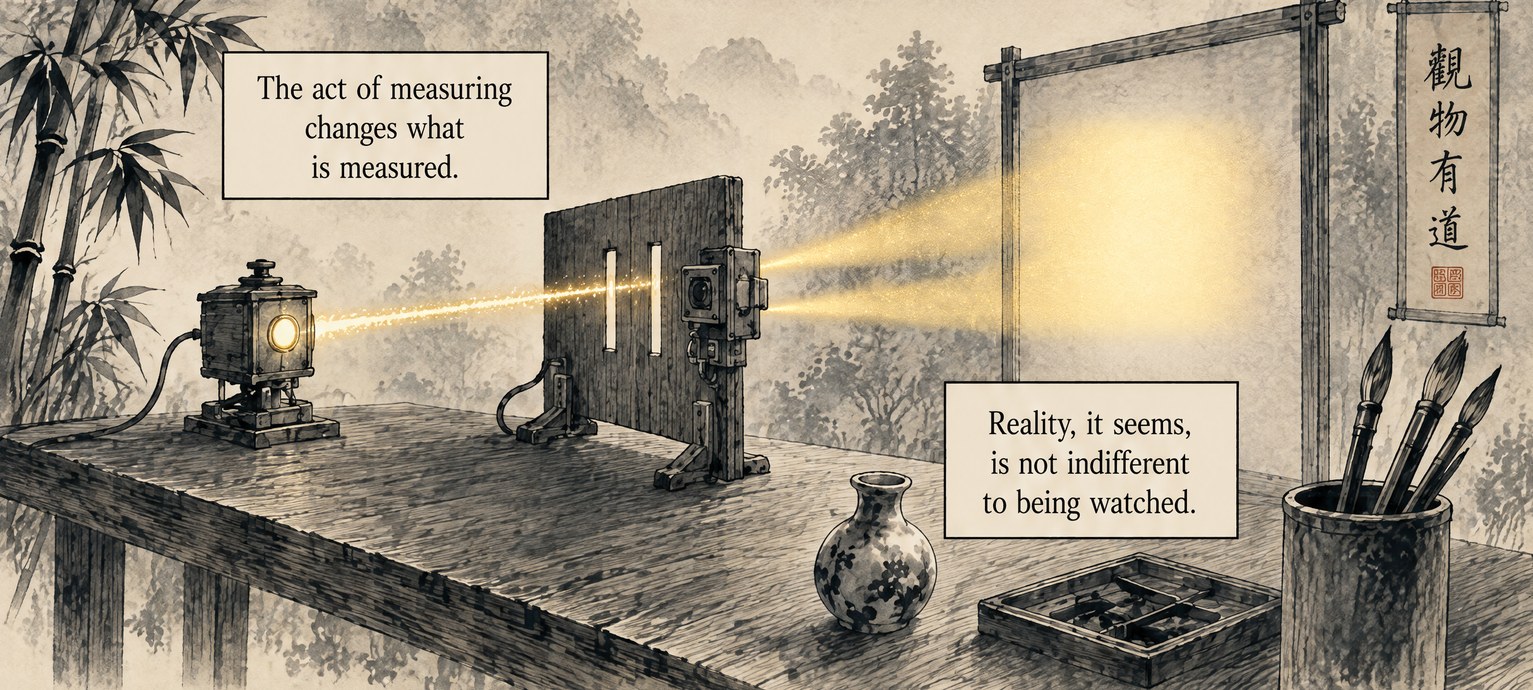
So looking seems to change the result. With no record of the path there are stripes. With a record, they vanish. The book's first verdict is that reality is “not indifferent to being watched”. In other words, it seems to care whether we look. Tap the three choices in turn. Notice the third, a record that nobody ever reads: the stripes still vanish. By page 14 the book sharpens “being watched” into something plainer: leaving a record.
For decades the usual story was a clumsy kick: to see the path you must bounce something off the light, and the bounce scrambles the stripes. Werner Heisenberg explained the limits of measuring in this way in 1927. Experiments like Rempe's show the kick is not needed. What counts is whether a record of the path exists anywhere. Whether a mind plays any deeper part in quantum physics is still argued, and the book comes back to it.
The stripes' contrast is the overlap of the two tag states:
a readable record: ⟨t_L|t_R⟩ = 0
so V = 0
Nothing in the formula asks whether anyone reads the tag.
Words to keep
- Interference
- What two waves do when they meet. They add up where crest meets crest and cancel where crest meets trough. It makes the stripes.
- Crest and trough
- The high points and the low points of a wave.
- Which-path record
- Any lasting trace of which slit the light took, like a tag saying left or right. Read or not, it removes the stripes.