Bertlmann's socks. Bell's test
Why odd socks are no mystery, and how a simple counting game shows that some pairs of particles are not like socks at all.
Socks are no mystery
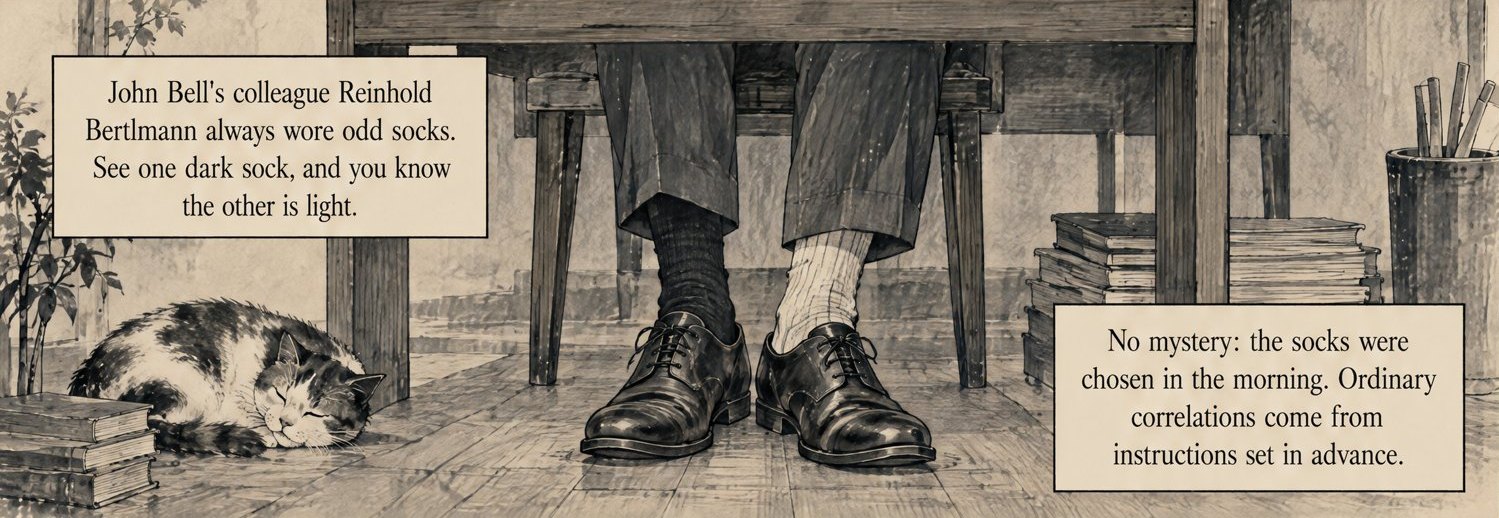
Reinhold Bertlmann, a colleague of the physicist John Bell, always wore odd socks. See one dark sock, and you know that the other is light. Nothing flies from one foot to the other. The answer was fixed in the morning, when he got dressed. Linked results that come from instructions set in advance are no mystery. Maybe tiny particles work the same way, each carrying its answers like an instruction card in its pocket. Physicists call such secret, pre-set answers hidden variables. Dress him, then peek at one foot.
Notice that your prediction is right every morning. Nothing travels between the feet: the answer was set when he dressed.
Bertlmann is an Austrian physicist who worked with Bell at CERN, the particle physics laboratory near Geneva. Bell named a 1981 paper after his habit: 'Bertlmann's socks and the nature of reality'. Einstein expected entangled particles to work like the socks. Each would carry its answer from the start, and looking would only reveal it. Bell's achievement was to turn that expectation into something an experiment could check.
Call the morning's choice λ, a hidden variable. Each result is fixed by it: left = A(λ), right = B(λ). For the socks B(λ) is always the opposite of A(λ), so:
Each foot alone is half and half, yet the pair is perfectly linked. That link is a correlation.
The instruction-card game
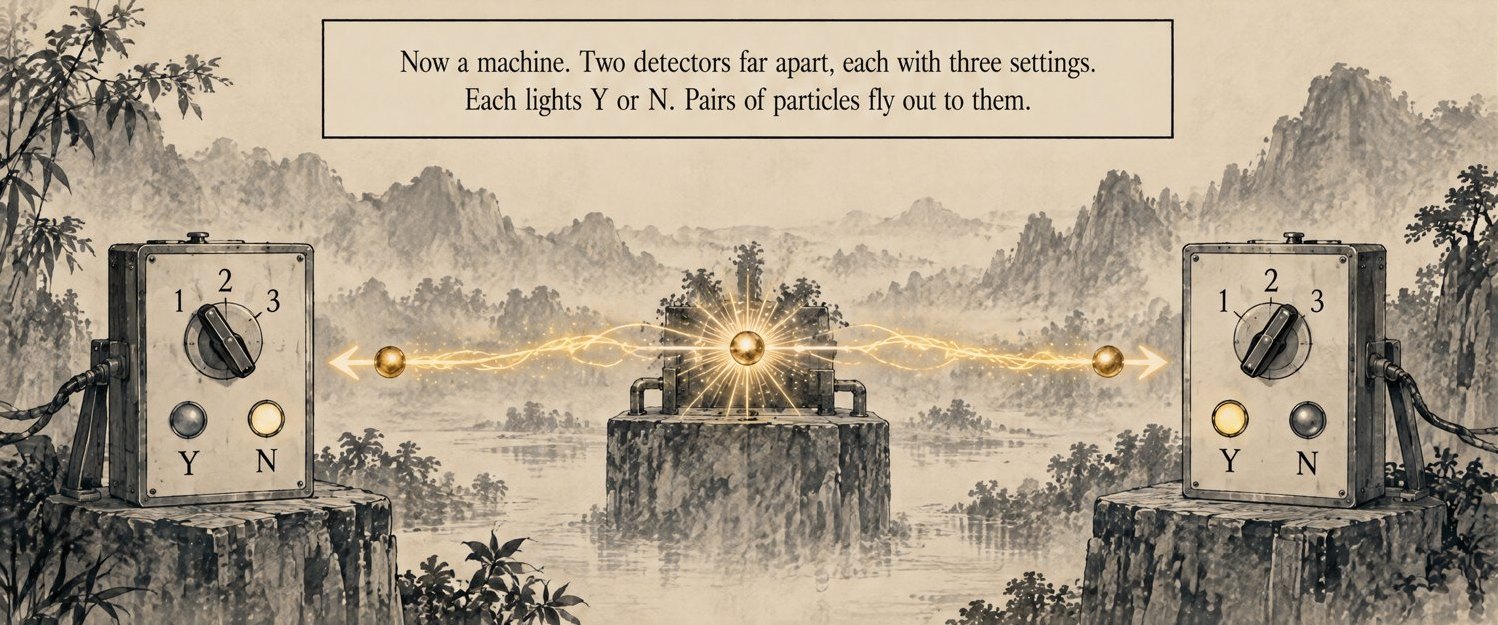
Now a machine. A source sends pairs of entangled particles: each pair can only be described together, like two coins that each land at random but always agree when compared. The two fly to detectors far apart. Each has a dial with settings 1, 2 and 3, and lights a lamp, Y or N. When the dials match, the lamps always agree. So maybe each pair carries an instruction card, like socks chosen in advance. YYN means Y on 1, Y on 2, N on 3. Pick cards and run it.
Share of pairs where the lamps agree your cardsfloor for any cards: 5 in 9
Notice that however you mix the cards, the share of agreements never settles below 5 in 9, about 56 percent.
This three-setting machine comes from the American physicist N. David Mermin, in 1981. The rule that matching dials always agree does real work. A lamp set to 2 must light whatever its partner would light on 2, so both particles must carry the same card. The dials are turned at random at the last moment, after the pair has left the source, so a card cannot know which settings are coming. It has to carry an answer for all three.
A card lists three answers a₁, a₂, a₃. With both dials random, each of the 9 setting pairs (i, j) has chance 1/9, and the lamps agree when aᵢ = aⱼ:
YYY gives 9/9 = 1. YYN gives 5/9 ≈ 0.556. For a mix of cards, P(agree) is the average over the mix.
Five in nine is the floor
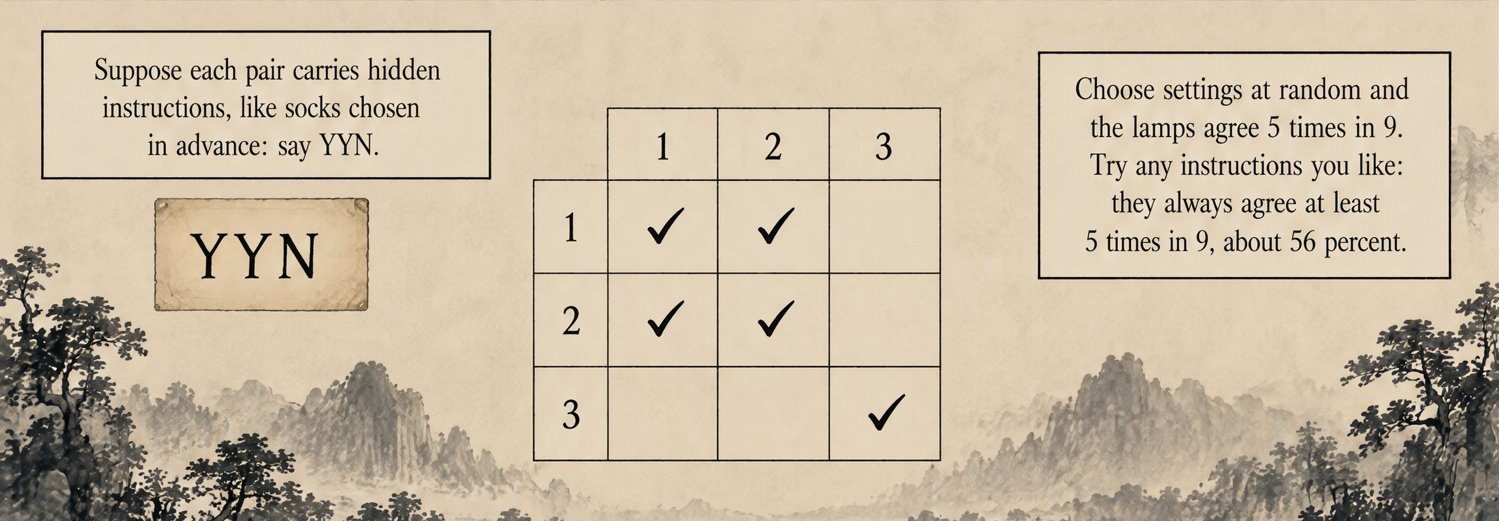
Count, as the book does. The two dials can be set in 9 ways: 1 and 1, 1 and 2, and so on. A card has three letters but only two kinds, Y and N, so at least two letters match. With YYN, the lamps agree whenever both dials point at a Y, which happens 4 ways, or both at the N, 1 way. That makes 5 in 9, about 56 percent. YYY agrees all 9 times. No card does worse than 5. Tap the letters to flip them and count again.
Notice that every card gets at least 5 ticks, however you flip it.
This counting needs no physics at all, which is why its conclusion is so hard to escape. It covers any mix of cards too: every card scores at least 5 in 9, so any blend of them does as well. It rests on three assumptions only. The answers are set before the dials are turned. One detector's lamp cannot depend on the other detector's dial. And the dials are turned freely. Section 5 looks at which of the three gives way.
A card with n_Y letters Y and n_N = 3 − n_Y letters N has n_Y² + n_N² agreeing pairs. Three letters split only as 3 + 0 or 2 + 1:
Real entangled pairs
Now swap the cards for real entangled pairs, the coins that land at random yet agree. Quantum physics predicts, and experiments find, that when the dials match, the lamps always agree, just as with cards. But when the dials differ, they agree only one time in four. Over random dials that makes exactly half the time, 50 percent, below the cards' floor of about 56 percent. No cards can do that. Run both machines side by side.
| Dials | Cards | Pairs |
|---|---|---|
| the same | no pairs | no pairs |
| different | no pairs | no pairs |
| all pairs | no pairs | no pairs |
Share of pairs where the lamps agree cardsentangled pairsfloor for cards: 5 in 9pairs in the long run: 1 in 2
Both machines get the same dial settings for every pair, so the comparison is fair. Run 3,000 pairs and notice the bottom row of the table: the cards stay at 56 percent or more, while the entangled pairs settle at 50.
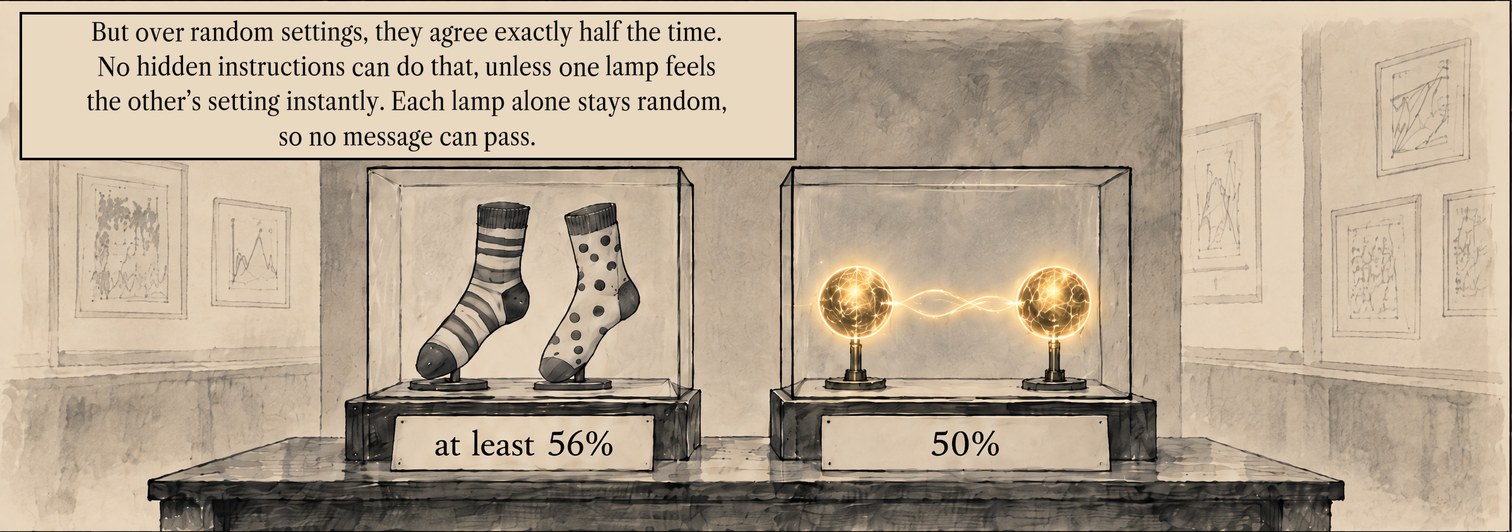
In the real version each particle has spin, a built-in magnetism, like a tiny magnet that always points up or down when tested along any direction. The three dial settings test it along three directions a third of a turn apart. A third of the time the dials match and the lamps agree. The other two thirds, they agree one time in four. Together that is a third plus a sixth, which is a half. Each lamp alone still flashes Y and N at random.
For a pair of spin-half particles measured along directions at angle θ, with one lamp's labels swapped so that matching dials agree:
With photons, polarisation plays the part of spin. There P = cos²θ, so the directions sit 60° apart instead.
Something has to give

If no cards can explain the lamps, one idea behind the cards must be wrong. Perhaps locality fails, the rule that nothing travels faster than light. Something then links the detectors, though never in a way that can carry a message. Perhaps the results were not set in advance, but appear only when tested. Or perhaps the dials and the pairs were secretly linked from the start. Most physicists conclude that pre-set answers, with no link between the detectors, are ruled out. Which idea gives way is still argued. Try to send a message.
The right lamp, its dial fixed on 1 shows Ylamps agreehalf
Notice that your friend's lamp shows Y half the time whatever you do with your dial. The link appears only when the two lists are compared.
Bell himself admired the pilot-wave picture, which takes the first way out openly. The Copenhagen view and QBism take the second. Superdeterminism is a minority view, defended by a few physicists such as Gerard 't Hooft. Many others find it too costly, since every experiment relies on settings being chosen freely. What Bell's test rules out is the pair of ideas together: pre-set answers and no link. It does not show that messages can travel faster than light.
Locality means A = A(i, λ) and B = B(j, λ): each lamp depends only on its own dial and the card. Free choice means λ does not depend on (i, j). Together these give the 5/9 floor. Entangled pairs still send no signal:
Only the joint chance P(agree | i, j) depends on both dials.
Put to the test
Bell's idea of 1964 was pure reasoning. Eight years later physicists ran the first real test, sending pairs of photons, coins of light, to two detectors. Real equipment is never perfect, so labs play a sturdier version of the game, with two settings on each dial, that turns the agreements into one score. Instruction cards can never score more than 2. Entangled pairs can reach about 2.83. Every careful test has gone the way quantum physics predicts. Make the equipment noisier and see when the test can no longer tell.
The lab score entangled pairslimit for any cards
Notice that below about 71 percent clean the score falls under 2, where instruction cards could fake it, so the test can no longer tell.
The first test was run in 1972 by Stuart Freedman and John Clauser in Berkeley. In 1982 Alain Aspect's team near Paris changed the settings while the photons were in flight. Early tests had loopholes, gaps that could in principle let pre-set answers fake a result, such as detectors that missed many particles. In 2015 teams in Delft, Vienna and Boulder closed the main ones together. The 2022 Nobel Prize in Physics went to Aspect, Clauser and Anton Zeilinger for this work.
The lab score is the CHSH score (Clauser, Horne, Shimony and Holt, 1969), with two settings per side. E is the average of +1 for agree and −1 for differ:
Noise that keeps a fraction V of the pattern gives S = 2√2·V, which beats 2 only when V > 1/√2 ≈ 0.707.
Words to keep
- Entanglement
- Two particles described only together, like two coins that each land at random but always agree. Their results match in a way no cards can explain, yet they cannot carry a message.
- Hidden variables
- Answers each particle might carry secretly from the start, like an instruction card in its pocket.
- Bell's test
- The counting game. Over random dials, pre-set answers must agree at least 5 times in 9, about 56 percent. Real entangled pairs agree only half the time.
- Locality
- The rule that nothing travels faster than light, so one detector cannot be affected by the other's dial.