Uncertainty. Heisenberg, 1927
Why nothing can have a sharp place and a sharp motion at the same time, and why that is a fact about waves, not about clumsy tools.
A pure hum goes on for ever
Sound travels through the air as a wave, like a ripple. A pure hum is one steady note, with one exact wavelength: crest after crest, all the same distance apart. A higher note has shorter waves. A perfectly pure hum has no start and no end, because starting or stopping would mix in other notes. So it fills the whole line, for ever. Where is the wave? Everywhere along the line, equally. One exact wavelength, and no place at all. Change the note, and tap to hear it.
A pure hum in the air one wavelength only
A perfectly pure note would have to last for ever, so it is an ideal. Real notes start and stop, and that always adds a little spread of pitch. A tuning fork comes close: it rings for many seconds on almost a single pitch. The rule is general. The longer a note lasts, the purer its pitch can be, and a very short blip has no clear pitch at all. The wavelength is the speed of sound, about 343 metres a second in air, divided by the number of vibrations a second.
A pure wave has one wavenumber k, and its height is spread evenly over every x:
With v ≈ 343 m/s in air, 220 Hz gives λ ≈ 1.56 m. Its spreads are Δk = 0 and Δx = ∞.
Mix wavelengths to make a pulse
A single clap is the opposite of a hum. It is sharp in time, over in an instant, but it has no clear pitch: it is a jumble of many pitches at once. Waves along a line work the same way. Add waves of slightly different wavelengths. At one spot their crests line up and add, but further away they drift out of step and cancel. What is left is a short pulse, a wave packet. Widen the mix and watch the pulse shrink.
The wavelengths in the mix, and how much of each
What they add up to, across 16 wavelengths the sumits outline
Joseph Fourier showed, in work on heat begun in 1807, that almost any shape can be built by adding plain waves. The trade you see here holds for every kind of wave: sound, light, water and radio. Engineers meet it all the time, because a very short radio pulse needs a very wide band of frequencies. This mix uses a bell-shaped spread of wavelengths, which gives the smallest product possible. Any other recipe gives a bigger product, never a smaller one.
The pulse on screen is a real sum of 51 plain waves, each with wavenumber kⱼ = 2π/λⱼ and a bell-shaped weight:
Measured as standard deviations, the two spreads obey a fixed rule. The page works them out from the sum itself:
Wavelength is motion
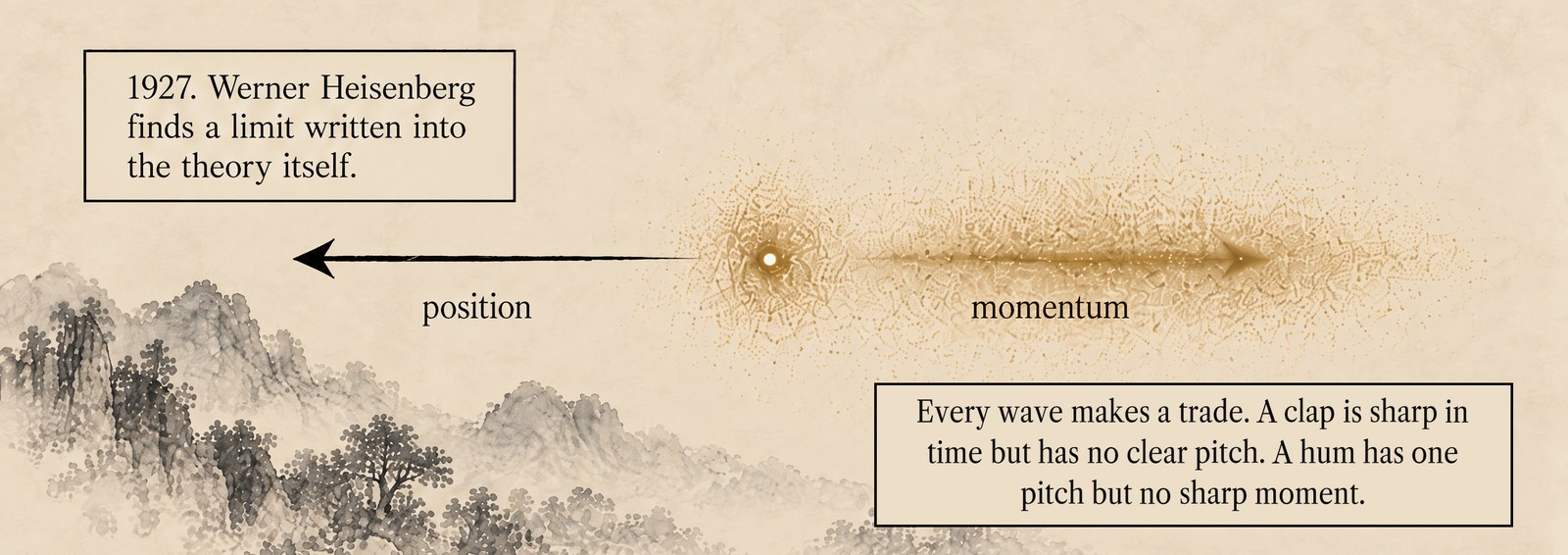
Now the step that turns this into physics. An electron's wave of possibilities has a wavelength too, set by how it moves: the faster it goes, the shorter its wave and the more momentum it has. Momentum is the push a moving thing carries. So pin its wave into a small space and, like the clap, it needs a jumble of wavelengths: a jumble of speeds at once. Let it spread out, like the hum, and its speed sharpens. Drag the pin, then measure some electrons.
Where it could be found its wave
How fast it could be going, in km/s
A nanometre (nm) is a millionth of a millimetre. Each dot is one fresh electron, prepared the same way and measured once: 20 caught to see where they are, 20 timed to see how fast they go.
Louis de Broglie proposed in 1924 that every particle has a wavelength set by its momentum, and in 1927 electron waves were seen bouncing off crystals. Heisenberg sent off his paper in March 1927. The spreads describe a crowd of electrons prepared exactly alike. Find each one and they turn up in different places. Time each one and they move at different speeds. Pin the crowd's place and their speeds scatter. Pin it hard enough and some even move backwards.
De Broglie's rule ties momentum to wavelength. Multiply Δx · Δk ≥ ½ by ħ:
The electron here moves at v₀ = 1,000 km/s on average, so λ₀ = h/mv₀ = 0.727 nm. Pinned to Δx = 0.10 nm, it has Δv ≥ 579 km/s.
Not clumsy tools
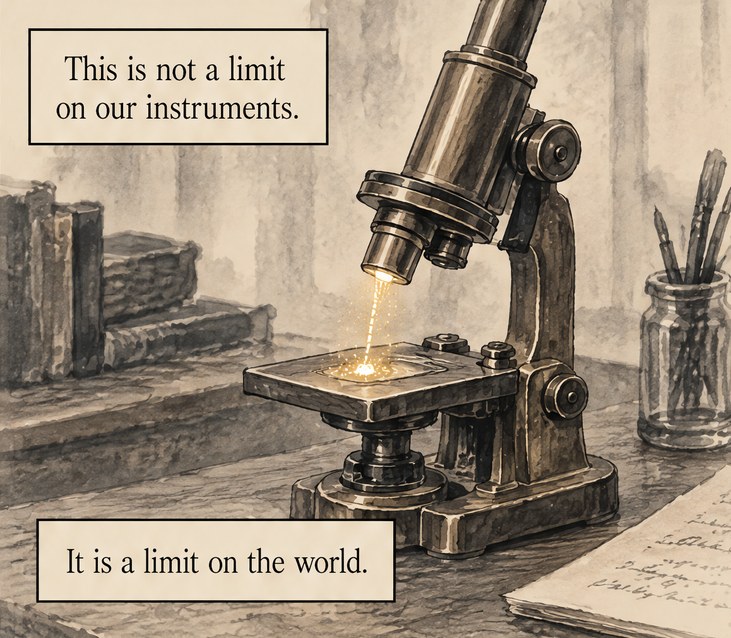
It is tempting to blame our tools: to see something that small you must bump it, the way a ruler can nudge a marble. But the blur is not caused by bumping. It comes from the waves themselves. No wave can be short like a clap and pure like a hum at once, so no particle can have a sharp place and a sharp motion at once, whether or not anyone looks. Push both sliders towards sharp and try to reach the forbidden corner.
An electron: spread of speed against spread of position the limit
Heisenberg's paper explained the limit with a microscope: to see an electron you must bounce light off it, and the light's kick disturbs it. Niels Bohr objected that this missed the real reason, which lies in the wave nature of matter and light. Heisenberg added a note before the paper appeared, admitting Bohr's point. Today the limit is stated as a property of the waves themselves. It holds even when each electron is measured only once, for its place or for its speed, so no kick is to blame. The kick picture still survives in popular accounts.
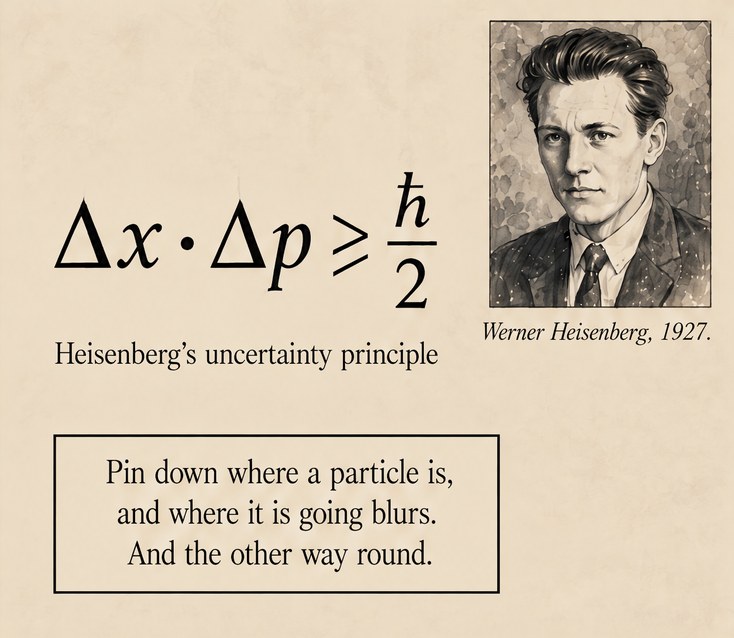
Earle Kennard proved the exact form later in 1927. Here each Δ is a standard deviation over many particles prepared alike:
Heisenberg's own 1927 estimate was rougher, δq δp ∼ h. The gold line on the chart is Δv = ħ / (2mΔx) for an electron, about 58 km/s at 1 nm.
Why a cricket ball never blurs
So why does a cricket ball not blur? Because of h, the tiny number from the first explainer that sets the size of nature's energy coins. The speed blur grows with h and shrinks with mass. For an electron, the lightest part of an atom, it is enormous. For anything you can hold, it is far too small ever to see. Pick each thing, pinned to the width of one atom, and compare its blur with everyday speeds.
Each rung of the ladder is ten times faster than the one below. Gold dots are speed blurs, ink marks are everyday speeds.
In everyday units h is a decimal point followed by 33 zeros, then 66. Against the 160 grams of a cricket ball that is nothing. Against an electron, which weighs about a billion billion billion times less than a gram, it is everything. That is why the quantum blur rules inside atoms and hides from daily life. Big things do not obey different laws. The same rule applies to them, but its blur is far too small to notice.
Electron (9.11 × 10⁻³¹ kg): 5.8 × 10⁵ m/s. Hydrogen atom (1.67 × 10⁻²⁷ kg): 315 m/s. Dust (10⁻¹² kg): 5.3 × 10⁻¹³ m/s. Cricket ball (0.16 kg): 3.3 × 10⁻²⁴ m/s.
Why atoms do not collapse
The electron and the centre of its atom have opposite electric charges, so they pull together, like a rubbed balloon and your hair. Why does the electron not fall in and sit on the centre? Its wave of possibilities forms a cloud around the centre. Squeeze the cloud smaller and, like a shorter clap, it needs a wider jumble of wavelengths, so it jiggles harder. Pull and jiggle balance at one size: the size of an atom. Squeeze the cloud and watch the energy.
Energy for each size of cloud. Lower is more settled totaljigglepull
Before quantum theory this was a real crisis. In the old picture of an electron circling like a planet, it should give off light and spiral into the centre in less than a billionth of a second, so atoms should not exist. Niels Bohr's model of 1913 simply declared that the electron could stand only on certain steps. Uncertainty gives a deeper reason: the cloud cannot shrink without its motion growing. It sets the size of atoms, and so helps set the size of everything made of them.
Take the push the squeeze demands, p ≈ ħ/r, and add the electric pull:
The lowest point is at
This rough estimate lands exactly on hydrogen's measured energy. With p ≈ ħ/2r instead it would be off by a factor of four, so treat it as a sketch. The full calculation gives the same −13.6 eV.
Not missing information
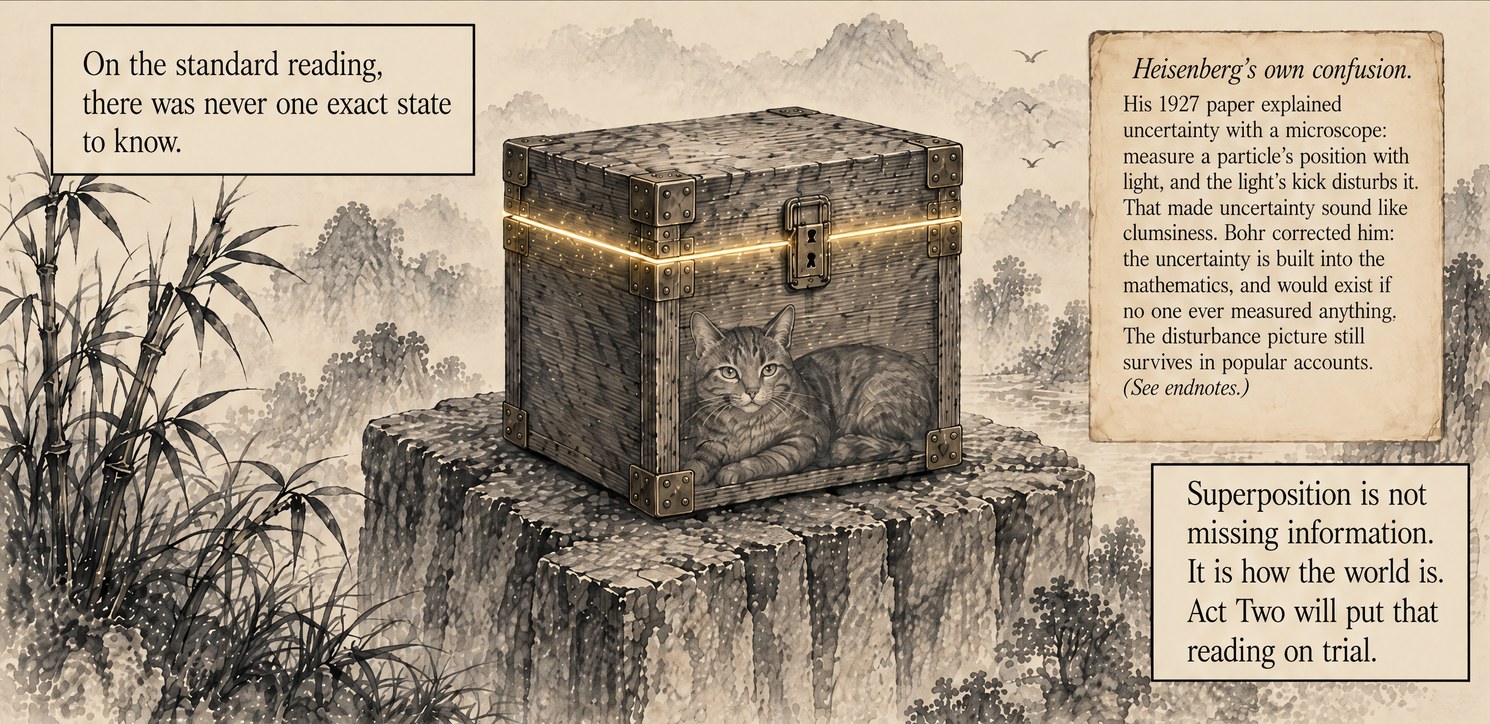
On the standard reading, the blur is not a secret hidden from us. The electron never had one exact place and one exact motion at the same moment. Its wave simply is a mix. Not everyone agrees. In the pilot wave picture of page 36, the particle rides its wave like a surfer and always has an exact place and speed, and the limit is on what anyone can know. Both readings predict exactly the same results. Act Two puts them on trial.
Earle Kennard proved the exact inequality later in 1927, and Howard Percy Robertson extended it to other pairs of quantities in 1929. Einstein never accepted that the limit was final and tried for years to beat it with thought experiments. On page 22 of the book he attacks it with a box. The brass microscope on this page is Heisenberg's own first picture, the one the card warns about. Its kick is real, but it is not the reason for the limit.
Words to keep
- Momentum
- How much push a moving thing carries. For a particle, a shorter wavelength means more momentum.
- Wave packet
- A short pulse made by adding waves of many wavelengths. Sharp in place, mixed in wavelength.
- Uncertainty principle
- Position and momentum can never both be sharp at once. Pin one and the other spreads.