The crack. Planck, 1900
Why a hot poker glows red, and how one desperate guess about lumps of energy saved physics from infinity.
Light is a wave
Throw a stone in a pond and ripples spread out. Light is a ripple too, far too small to see. The distance from one crest, or high point, to the next is its wavelength, and it decides the colour. Red light has long, lazy waves. Violet light has short, quick ones. How many crests pass each second, how fast the wave wiggles, is its frequency. Beyond red lies invisible infrared, felt as warmth. Beyond violet lies invisible ultraviolet, which causes sunburn. Slide through the colours. Notice that shorter waves wiggle faster.
Wavelength and frequency are two sides of one fact. All light travels at the same speed, about 300,000 kilometres a second, so a shorter wave must wiggle faster to keep up. Our eyes see only a narrow band, from about 380 to 750 nanometres. Longer waves are infrared, which you feel as warmth from a radiator. Shorter ones are ultraviolet, which causes sunburn.
Speed equals wavelength times frequency:
Red at λ = 700 nm gives ν ≈ 4.3 × 10¹⁴ Hz. Violet at 400 nm gives ν ≈ 7.5 × 10¹⁴ Hz.
Hot things glow
Heat makes the atoms in a poker jiggle, and jiggling atoms send out light waves. Hotter means more jiggling: more light, and more of the short, quick waves. That is why a heated poker goes from dull red to orange to almost white. Drag the heat. Notice the peak of the curve, the brightest wavelength, sliding from infrared towards the visible colours.
How much light comes out at each wavelength what hot things really do
Most of the light is infrared: warmth you can feel but not see. Red is simply the first visible colour to appear.
K is kelvin, a temperature scale that starts at the coldest possible point, about minus 273 °C. In the 1890s physicists in Berlin measured exactly how much of each colour a hot oven gives off. The curve was the same for every material: only the temperature mattered. Double the temperature and the brightest wavelength halves, a rule Wilhelm Wien found in 1893.
Wien's law for the peak, and the curve itself, which is Planck's law:
The old prediction
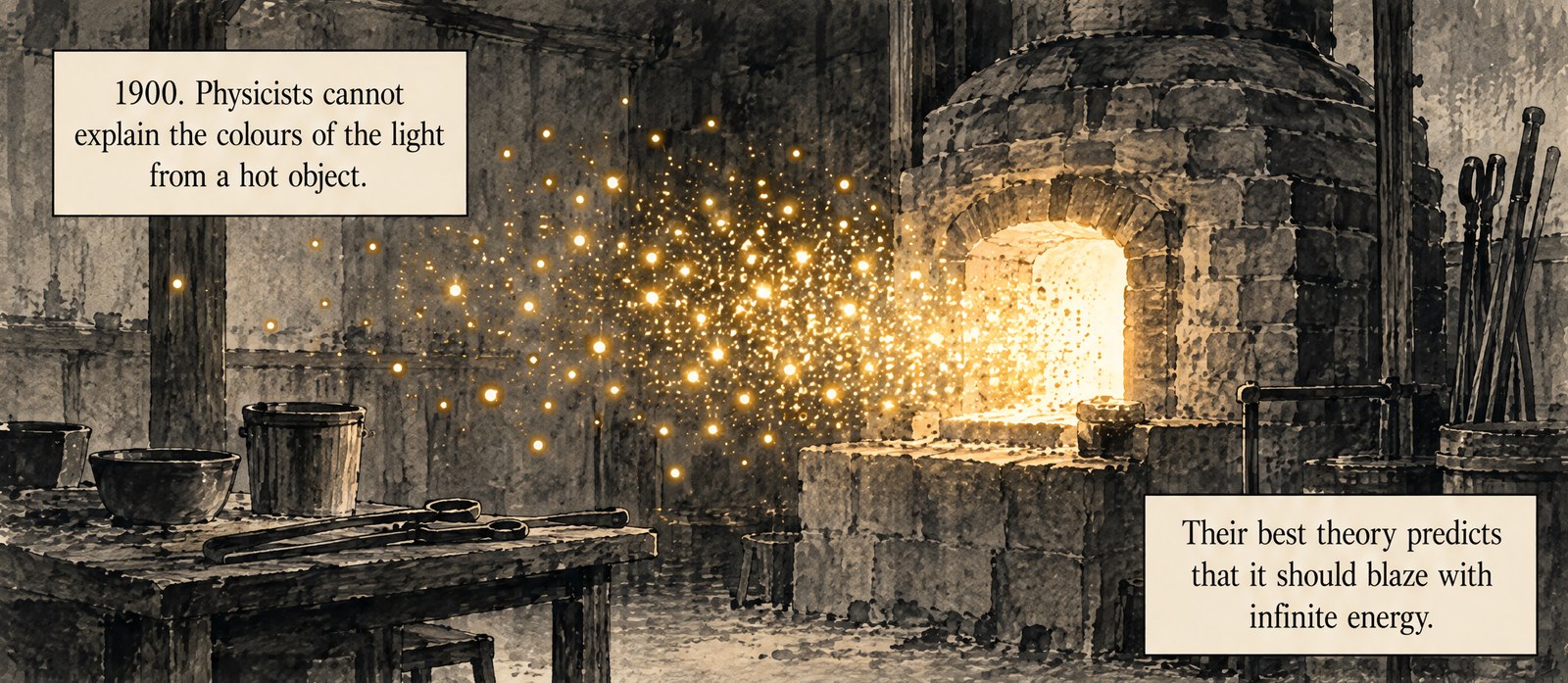
Inside a hot oven, light waves bounce between the walls. Like a skipping rope held at both ends, only waves that fit exactly can stay: one hump, two, three, and so on. Short waves fit in far more ways. The old rule gave every way of wiggling the same pocket money of heat. The list of short waves never ends, so the money needed has no end, and the oven should blaze with infinite energy. Switch the old prediction on and off. Notice its dashed line racing off the chart at the short end.
Ways a wave can fit inside the oven
An oven at 1,500 K real ovensthe old prediction
The old rule is called equipartition: in heat, every way of moving gets the same average share. It works beautifully for gases. For light in an oven it fails at the short end. Lord Rayleigh and James Jeans worked out the prediction between 1900 and 1905, and in 1911 Paul Ehrenfest named its failure the ultraviolet catastrophe. Planck did not start from this problem. He was chasing precise Berlin measurements that no formula yet matched.
Each way of wiggling (a mode) gets an average energy kT. The number of modes per unit wavelength grows as 8π/λ⁴, which gives the Rayleigh-Jeans law. It runs to infinity as λ goes to zero:
Energy comes in lumps
Planck's fix: energy can only be paid out in whole lumps, like coins. The quicker a wave wiggles, the bigger its coin, so violet coins are big, red coins small, infrared ones smaller still. Each wave still gets the same pocket money from the heat. If one coin costs far more than that, the wave almost never gets one. The endless short waves get almost nothing, and the total stays finite. Pick a colour, then change the heat. Notice the violet and ultraviolet gold bars shrinking to almost nothing.
Energy each wave really ends up with old rule: the same for allpaid in lumps
Planck found his formula in October 1900, and it fitted the Berlin measurements perfectly. In December he showed that it follows if energy comes in lumps. He applied the lumps only to the jiggling matter in the oven walls, not to light itself. The "pocket money" is the average share of heat the old rule promised every wave. With lumps, a wave either gets a whole coin or nothing, and big coins are rarely affordable.
One lump is E = hν. The pocket money is kT, Boltzmann's constant times the temperature. The chance that a wave holds at least one lump, and its average energy, become:
When hν is much smaller than kT, ⟨E⟩ goes back to kT. When it is much bigger, ⟨E⟩ falls towards zero.
Shrink the coins, and the infinity comes back
A tiny number, written h, sets how big the coins are. Make h smaller and every coin gets cheaper, so the oven can afford more and more violet light. At zero, coins cost nothing and you are back at the old prediction, with infinite energy. Nature's h is tiny, but it is not zero, and that makes all the difference. Drag the size of h. Notice the gold curve climbing towards the dashed old prediction as h shrinks.
An oven at 1,500 K with your hthe old prediction
h is called Planck's constant. Since 2019 it has had a fixed value by definition, and the kilogram itself is defined from it. Halving h would make a hot oven give off eight times as much energy.
Total power per area is σT⁴ with σ = 2π⁵k⁴ / (15c²h³), so it scales as 1/h³. As h → 0, Planck's law turns into the Rayleigh-Jeans law.
A staircase, not a ramp
Coins mean steps. A thing can only gain or lose energy one coin at a time, so its energy climbs like a staircase, never like a smooth ramp. The size of each step depends on how fast the thing wiggles. A swing rocks slowly, so its steps are far too small to ever notice. Inside an atom, things wiggle incredibly fast, so the steps are big. Pick something and look at its steps. Notice that the swing's steps blur into a smooth ramp, while the atom has a few big ones.
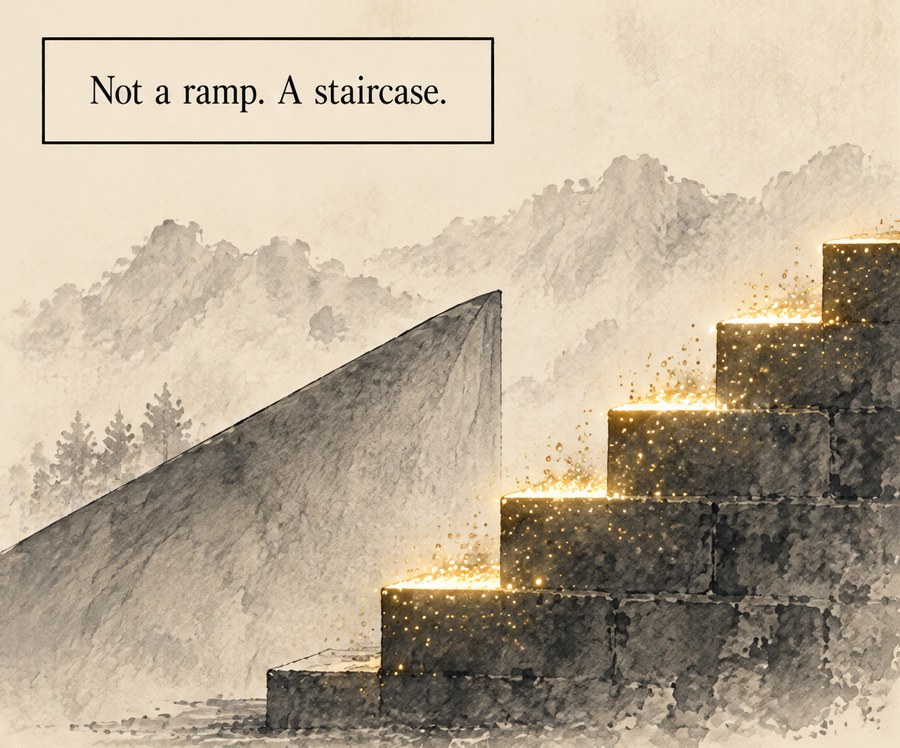
A swing rocks about once every two seconds and carries tens of joules of motion, so it would take some 10³⁵ steps to get it going. A nitrogen molecule in the air wiggles about 70 trillion times a second. Its steps are some ten times bigger than the heat it gets at room temperature, so it nearly always sits on the bottom step. That is the same rule that keeps violet light out of the oven.
A swing at 0.5 Hz has steps hν ≈ 3.3 × 10⁻³⁴ J. N₂ at ν ≈ 7.0 × 10¹³ Hz has hν ≈ 0.29 eV, against kT ≈ 0.025 eV at room temperature.
He did not want it
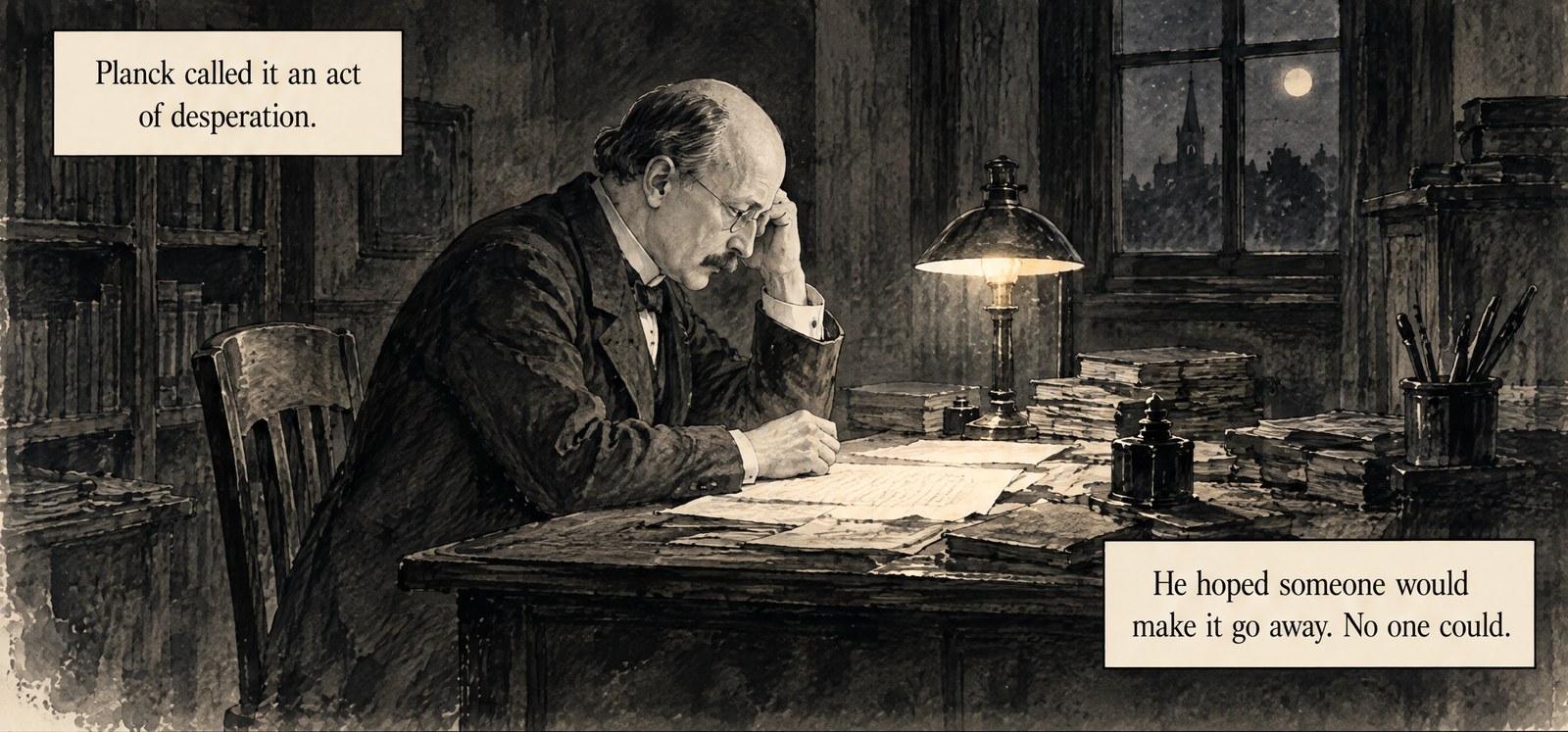
Planck loved the old physics. He used the lumps as a trick to make his formula fit the measurements, and he hoped someone would later find a smoother explanation. No one ever did. Five years later Einstein went further and said that light itself comes in lumps. That is the next explainer.
Looking back in a letter of 1931 to the American physicist Robert Williams Wood, Planck called his guess an act of desperation. He was cautious and hoped to save the old physics. Making light itself lumpy was Einstein's bolder step, in 1905.
Words to keep
- Wavelength
- The distance from one crest of a wave to the next. For light, it is the colour.
- Frequency
- How many times a wave wiggles each second. Short waves wiggle fast.
- Quantum
- The smallest lump of something, here of energy. The plural is quanta.
- Planck's constant, h
- The tiny number that sets the size of nature's energy steps. Never zero.